
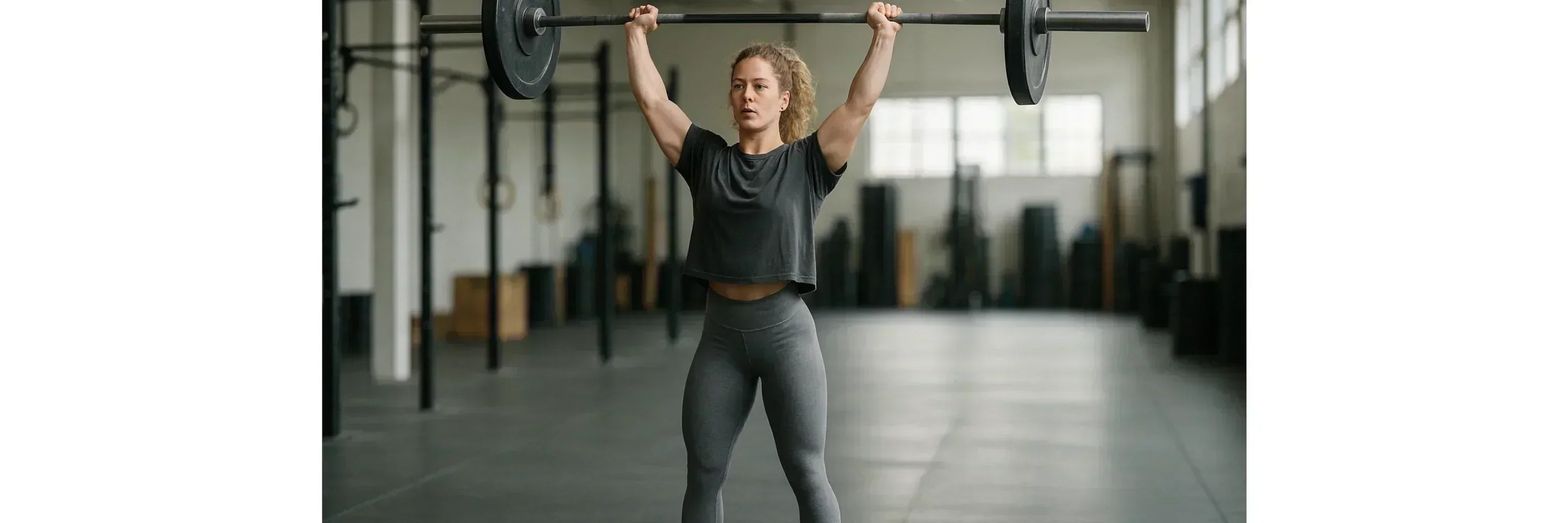
Overhead press for strong shoulders and more progress in CrossFit
Overhead pressing is one of the absolute fundamental exercises in strength training. Hardly any other movement strengthens the shoulders as directly and effectively. At the same time, you are training your core, arms, and even parts of your chest. It is no wonder, therefore, that overhead pressing is a staple of good training plans in the gym, weightlifting, and CrossFit. However, not all overhead presses are the same: there are various versions such as the strict press, the military press, dumbbell overhead press, or machine shoulder press. Each variation has its benefits, targets specific muscle groups slightly differently, and is suitable for different training goals. But what should you look for when performing overhead presses? What variations exist, and what is the difference between the strict press and the military press?
In a nutshell
Less text, more impact – your shortcut to understanding.
- Overhead pressing forms the basis for overhead movements in CrossFit.
- The standing version trains almost the entire upper body.
- The only difference between the strict press and the military press is the stance width.
Let’s get started
What is an overhead press
In an overhead press, a weight is pushed from the shoulder over the head. Usually, this involves a barbell or dumbbells; in gyms, it is often done using a guided machine. The goal is to move the weight upward using only the strength of the shoulders and arms. The legs and hips remain still—no momentum, no help from other parts of the body. This is exactly what makes the exercise so valuable: you force the shoulders to do the main work.
Which muscles do you train with the overhead press
The overhead press is a multi-joint exercise. As the name suggests, you do not just move a single joint, but work with several simultaneously, thereby training several muscle groups at the same time.
The most important muscles involved are:
Anterior and lateral deltoids: They perform the main work and ensure the arms are guided upward.
Triceps: Assist in extending the arms and stabilize the upper part of the movement.
Upper chest: Is slightly involved, especially at the beginning of the movement.
Core musculature: Abdominal and back muscles work permanently to keep the torso stable and upright.
Trapezius: Stabilizes the shoulder blades when the arms move overhead.
How to perform the overhead press correctly
Set the starting position: Stand hip-width apart, with feet firmly anchored in the floor. Grip the barbell slightly wider than shoulder-width. Position the bar at the level of the upper chest, just below the collarbone.
Build tension: Brace your abs and glutes firmly to avoid an arched back. The elbows should point slightly forward, not completely outward. Actively pull your shoulder blades back and down.
The pressing movement: Press the bar straight up. Move your head back slightly so the bar can travel in a straight line upward. Fully extend your arms and actively push your head between your arms.
Lowering: Lower the bar slowly and in a controlled manner back to shoulder height. Maintain tension throughout your entire body and avoid arching your back.
Imagine you are pushing yourself under the bar, rather than pushing the bar upward. This keeps you stable and safe.
Common mistakes during the overhead press
Arched back: Occurs when there is a lack of core tension or the weight is too heavy.
Too much momentum: Anyone using their legs for help is no longer doing a strict press, but a push press. Consciously make sure to keep your legs still.
Incorrect movement path: The barbell is pushed forward, which makes it unstable. Ensure a vertical line over the body's center of gravity.
Elbow position: If the elbows point too far back, you lose control. Make sure to keep them in front of the weight.
Variations of the overhead press
Strict Press: The classic version in CrossFit and weightlifting. It is performed standing with a barbell, with feet about hip-width apart. The legs and hips remain completely extended and do not assist—the entire work is done by the shoulders, triceps, and core. Perfect for anyone wanting to develop maximum shoulder strength and improve their overhead position.
Military Press: Is almost identical to the strict press but is performed with a very narrow foot stance. This makes the exercise stricter, requires more core tension, and makes the range of motion slightly harder. A traditional variation often used in bodybuilding or classic strength training.
Dumbbell Overhead Press: Here, you press two dumbbells upward simultaneously or alternately. Advantage: Each side must work independently, which can correct muscle imbalances. Additionally, this variation allows for a more natural movement since the arms can move freely. This version is usually performed seated on a training bench. Especially suitable for those wanting to improve shoulder mobility and build symmetry.
Machine Overhead Press: With the machine press, the movement is fixed. This reduces the risk of technical errors and makes the exercise particularly interesting for beginners or rehab training. However, the core work is omitted because the machine stabilizes the movement. Good for beginners or for targeted muscle growth when you want to focus entirely on shoulder load.
What does the overhead press do for your CrossFit
Basis for overhead movements: Exercises like thrusters, push presses, push jerks, overhead squats, or snatches require a stable overhead position. A strong strict press ensures you can perform these movements more safely and efficiently.
Strong core: Due to the upright posture and pressing overhead, the core is intensely trained as well. This improves your body tension and protects you from arching your back or becoming unstable during complex lifts.
Transfer to gymnastics: Handstand push-ups, handstand walks, or even dips directly benefit from the strength built through overhead pressing. Getting stronger here automatically improves your gymnastics skills.
Injury prevention: Overhead pressing strengthens not only the shoulder muscles but also stabilizing structures like the rotator cuff. This makes you more resilient against overloading.
Better performance in training: Good overhead press performance helps you move more weight, hold out longer, and master workouts with better technical form.
Conclusion
The overhead press is an effective exercise for a strong upper body. It strengthens not only the shoulders but also the arms, chest, and core, laying the foundation for many other movements in strength training and CrossFit. With the different variations, you can perfectly adapt the exercise to your goal, whether it's strength building, muscle growth, or stability. Those who train overhead presses regularly will become not only more capable but also more resilient.



