
Learning Toes to Bar: Technique, Muscles and Progression
Toes to Bar are one of the signature exercises in CrossFit and are firmly anchored in many workouts. At first glance, the execution often looks like child's play: athletes hang seemingly effortlessly from the pull-up bar and swing their feet upward in a fluid motion until their toes touch the bar. However, there is much more to this exercise. Toes to Bar are a complex interplay of core strength, hip mobility, shoulder stability, and stable body tension. They demand not only strength but also technique, a sense of rhythm, and a good understanding of one's own body control. That is exactly what makes them so valuable and challenging at the same time. Whether you want to specifically strengthen your core muscles, improve your coordination, or prepare for your next CrossFit workout: Toes to Bar are an exercise that helps you in many ways and shows you how closely strength and technique are linked in training. The leap from the first hanging knee raise to the first clean repetition takes most people 6–12 weeks — provided you know the intermediate steps.
In a nutshell
Hang, swing, toes to the bar — CrossFit core in one movement.
- What it is: While hanging from a pull-up bar, you move your legs upward in a controlled manner until your toes touch the bar.
- What it trains: Abdominal muscles, hip flexors, grip strength, shoulder stability — and above all, the connection between hip momentum and core tension.
- From beginner to Toes to Bar: Knee raises → Leg raises → Hollow hold → Kip swing → Kipping knee raises. The five-stage progression will get you to your first clean repetition.
Let's get started.
What is a Toes to Bar
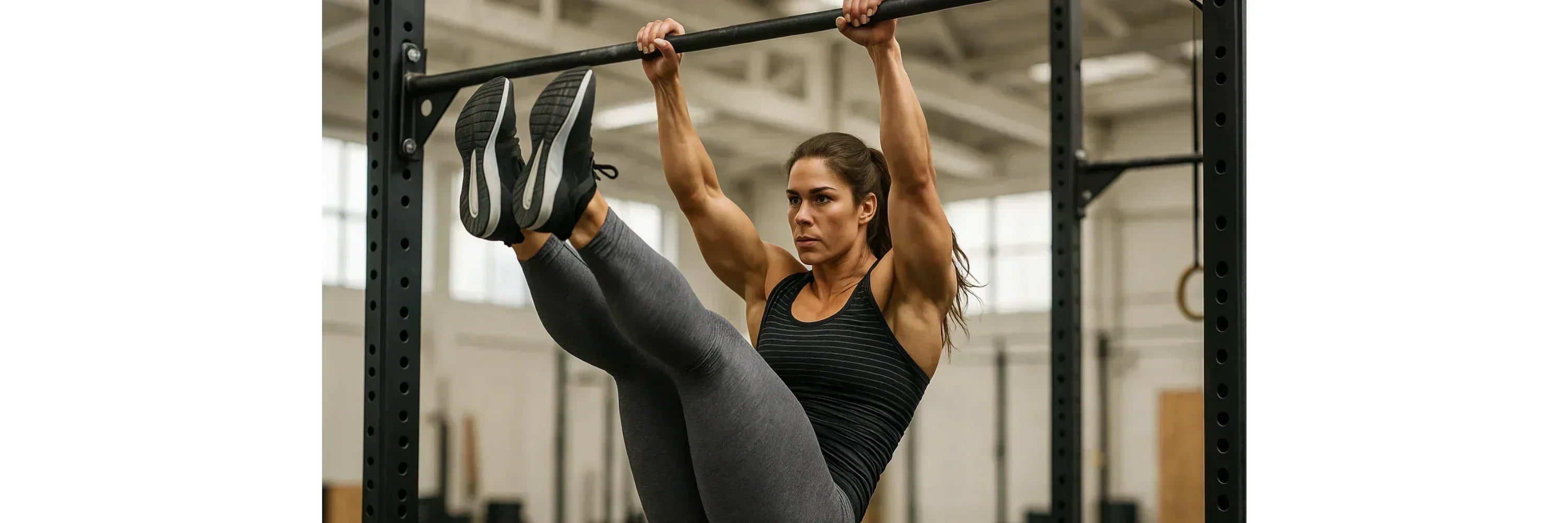
The name of the movement basically tells you what it is about. In a Toes to Bar, your toes touch the pull-up bar. The starting position is hanging from the bar. From there, you bring your legs up so that your toes reach the bar. Depending on the variation, this is done with pure muscular strength or by specifically using momentum and technique.
How to perform a Toes to Bar
Strict Toes to Bar: The strict variation is the basis of all Toes to Bar and simultaneously the most demanding in terms of technique and strength. You hang from the pull-up bar with straight arms, and your body is stable and controlled. From the very beginning, body tension is crucial: the abdomen and glutes must be firmly engaged so that you do not allow any uncontrolled movements. From this stable position, you move your legs slowly and powerfully upward until your toes touch the bar. The movement occurs without momentum, purely from the strength of your abdominal muscles and hip flexors. Just as controllably, you bring your legs back down to the starting position. This variation is particularly effective for building muscle in the core, but it requires a lot of strength, mobility, and strong grip strength.
Kipping Toes to Bar: The most well-known variation in CrossFit is the Kipping Toes to Bar. This is where momentum comes into play. Instead of moving your legs upward in isolation using muscular strength, you use the kip swing, a rhythmic swinging of your body back and forth. The decisive impulse comes from the hips: when you swing forward from the back position, you bring your hips up explosively and use that momentum to pull your legs upward with force. The toes touch the bar, and from this position, you flow directly into the next swing. When performed correctly, a uniform rhythm is created that allows you to complete many repetitions in a row. This variation is significantly more efficient than the strict one because it saves strength and is primarily used in workouts with high repetition counts.
Toes to Bar muscles: Which muscle groups are trained?
- Primarily: Rectus and oblique abdominal muscles, hip flexors
- Secondarily: Latissimus, shoulders, forearms, and grip strength
- Stabilizing: Glutes and lower back
What are the benefits
Strengthens the entire core: Toes to Bar is an effective exercise when it comes to strengthening your core muscles. Unlike many classic abdominal exercises like sit-ups or crunches, the entire core is engaged here. This improves not only the appearance of your abdominal muscles but also your stability in almost all other exercises.
Improves body tension and coordination: To actually get your toes to the bar, you need more than raw strength. The key is to learn to engage your entire body in a controlled manner and to coordinate movements precisely. Especially with multiple repetitions, it becomes clear how important a clean rhythm is. This skill also carries over to many other exercises in CrossFit, where body tension and timing determine success or failure.
Promotes grip strength and shoulder stability: Just hanging from the pull-up bar puts tremendous demands on your forearms and finger strength. With every workout, you incidentally build strong grip strength that will benefit you not only in pull-ups or deadlifts but also in everyday life. At the same time, your shoulder and back muscles work continuously to keep your body stable while hanging. This improves your shoulder health, prevents injuries, and ensures that you remain capable of performing in the long term.
Increases efficiency in workouts: In many CrossFit workouts, especially Metcons, the goal is high repetition counts in a short time. Anyone who masters Toes to Bar cleanly saves not only energy but also valuable seconds.
Transfer to other exercises: An often underestimated benefit is the interaction between the hips and the upper body. The explosive hip movement is the key to many CrossFit skills, whether it's the muscle-up, the kipping pull-up, or even Olympic lifting, such as the clean or snatch. Toes to Bar train exactly this connection: you learn to combine power from the hips with the stability of the upper body. This makes Toes to Bar an exercise that goes far beyond mere core training and takes your entire workout to a new level.
How you can learn the Toes to Bar
Hanging Knee Raises: A good entry-level exercise is knee raises. You hang from the pull-up bar and pull your knees toward your chest in a controlled manner. You will immediately feel your abdominal muscles working. Make sure you don't just perform the movement using momentum, but consciously control it from your core muscles. This exercise not only strengthens your abs but also gets you used to holding your body while hanging.
Hanging Leg Raises: The progression to hanging knee raises is leg raises with straight legs. You hang stably from the bar again and bring your legs straight up. You have to exert significantly more strength in your hip flexors and abdominal muscles than with knee raises. The goal is to bring your legs as high as possible without arching your back or letting momentum do the work. This exercise is already close to the Toes to Bar movement, although your feet do not touch the bar.
Hollow Body Holds: The hollow hold is a classic core exercise that is often underestimated but is extremely important for Toes to Bar. You lie on your back, arms stretched behind your head, legs stretched forward. Now, lift your arms and legs a few centimeters off the ground so that only your lower back touches the floor. Your body forms a slight banana shape. In this position, you hold the tension without arching your back. The hollow hold teaches you to maintain body tension — exactly what you need for kip swings on the bar.
Kip Swings: To learn the technique of Toes to Bar, kip swings are indispensable. You hang from the pull-up bar and practice rhythmic swinging back and forth. It is not a wild swinging back and forth, but a controlled movement in which you alternate between the hollow position and the arch position. It is important to initiate the movement from the hips and not just work with the shoulders. These swings are the foundation for all dynamic movements on the pull-up bar — whether kipping pull-ups, chest to bar, or Toes to Bar.
Kipping Knee Raises: You start with the kip swing. Out of this swing, you bring your knees explosively upward toward your chest. It is important that you initiate the impulse from the hips and immediately engage your abdominal muscles so that the knees are guided upward fluidly. Afterward, let your legs glide back into the starting position without losing body tension and go directly into the next swing. The great advantage of this exercise is that you learn to combine strength and rhythm. You get used to actively using your hips while simultaneously maintaining core tension — exactly what is crucial for Toes to Bar later on. At the same time, the movement remains slightly easier because the knees generate less leverage compared to straight legs. This allows you to practice the movement sequence under more controlled conditions and build the foundation for the full Toes to Bar movement step by step.
What are common mistakes
Insufficient body tension: Without tension in the core, you lose momentum and control.
Pulling only with the arms: The power comes primarily from the hips and abs, not from the arms.
Poor kip swing: Swinging too much makes you slower and costs energy.
Hyperextended back: Ensure a stable core position to protect the lumbar spine.
Not using grips: Toes to Bar put enormous strain on the hands, as strong friction occurs between the palm and the bar with every repetition. Grips protect your skin from blisters and tears and ensure that you can train without discomfort even with many repetitions. At the same time, they improve your grip on the bar, which means your forearms fatigue more slowly and you stay in rhythm more reliably.
Conclusion
Toes to Bar are far more than just an impressive movement on the pull-up bar. They belong to the standard exercises in CrossFit and combine strength, technique, and body control in a unique way. Whether in the strict execution for maximum core strength or in the dynamic variations for more efficiency, this movement challenges the entire body while providing a directly noticeable training effect on the abs, hips, and grip strength. Anyone wanting to learn the exercise properly will benefit from preparatory steps like knee raises, hollow holds, or kip swings to build strength and technique incrementally. At the same time, it is worth avoiding typical mistakes like lacking body tension or sloppy kip swings and taking care of hand protection with grips. When performed correctly, Toes to Bar will bring you not only strong core muscles and better grip strength, but also better coordination and efficiency in workouts.



