
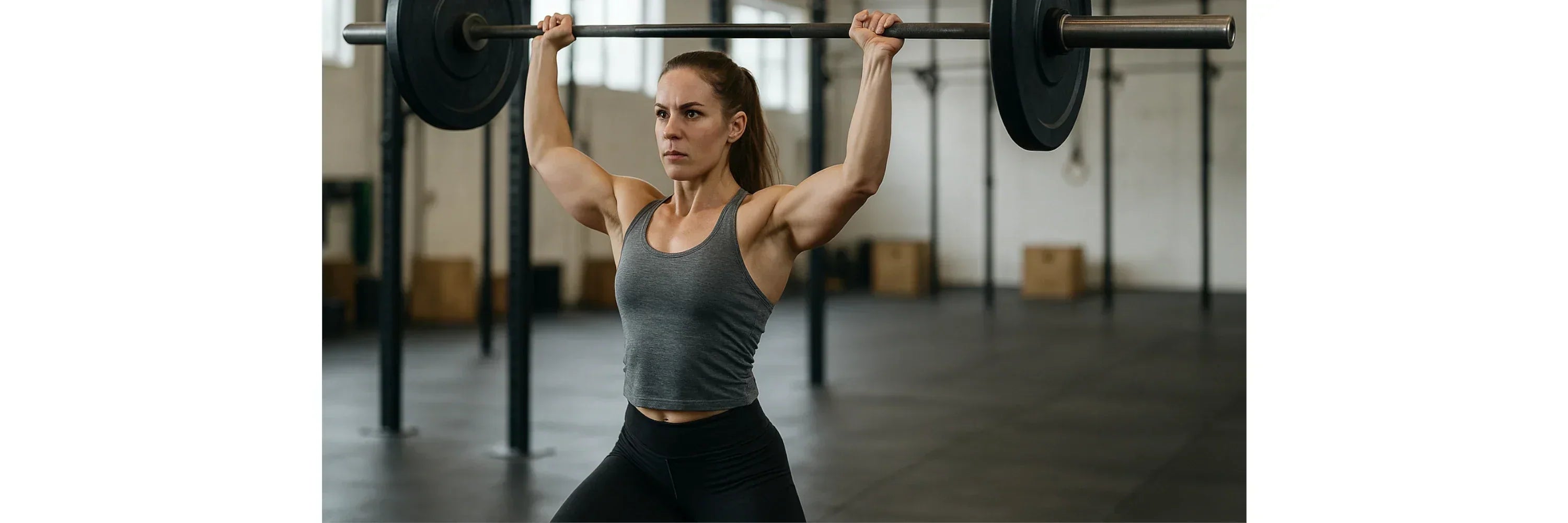
These assistance exercises will get you making progress in weightlifting again.
Weightlifting, with its two disciplines, the snatch and the clean and jerk, is a highly complex sport that requires strength, explosiveness, technique, and mobility. To improve in these two disciplines, it is not enough to train only the main lifts. Instead, assistance exercises play an important role in getting better. In this blog article, we take a detailed look at the best assistance exercises and explain what they help you with.
Why assistance exercises are important for weightlifting
Assistance exercises are an essential part of training for weightlifters because they support the main movements in a variety of ways. One of the most important benefits is the targeted correction of weaknesses. Many athletes have specific deficits in strength, mobility, or technique that can be effectively improved through specialized exercises. Furthermore, assistance exercises help to improve baseline strength by training muscle groups that are only secondary in the main lifts. Moreover, they offer the opportunity to train technical problems in isolation, as less complex movements allow for a focus on specific phases of the main lifts. Another crucial aspect is injury prevention, as the risk of injury is reduced by building a strong foundation and improving mobility.
The best assistance exercises in weightlifting
Front Squats: Are one of the most important assistance exercises in weightlifting. They serve to increase strength in the anterior chain, particularly in the quadriceps and the core. Furthermore, they improve stability and posture in the clean catch position, making them an indispensable exercise. A variation that is particularly effective is the pause front squat, where the deepest position is held for 2 to 3 seconds to further develop control and strength.
Overhead Squats: Are another outstanding assistance exercise. They not only improve stability and mobility in the overhead position but also train balance and core strength. A dynamic variation that is also very effective is the snatch balance, in which the barbell is explosively pressed into the overhead position.
Back Squats: Are ideal for expanding the general strength base. They work the entire leg musculature such as the posterior chain, including the glutes and hamstrings.
Snatch Pulls and Clean Pulls: Focus on the first and second pull phases and help to improve explosiveness and the bar path. These exercises can certainly feel heavy. However, be sure to maintain correct technique.
Push Press and Power Jerk: Build shoulder and tricep strength and improve explosiveness in the jerk.
Strict Press: Is an excellent exercise for improving shoulder strength and stability. It differs from the push press in that it is performed without momentum from the legs. This places the focus entirely on the shoulders and triceps.
Hang Power Snatch and Hang Power Clean: Sharpen explosiveness and technique during the second pull and help to find the correct position in the catch phase.
Deadlifts: Is a fundamental exercise that engages almost every muscle in the body, with a special focus on the posterior chain, the lower back, and grip strength. In the context of weightlifting, deadlifting helps to create a strong foundation for the first pull phase and to strengthen the back muscles for heavy loads.
Deficit Deadlifts: Through their greater range of motion, they provide an intense workout for the leg and back muscles and strengthen the first pull phase.
Romanian Deadlifts: Are excellently suited for strengthening the posterior chain and improving tension in the lower back.
Hip Thrusts: Train this hip extension in an isolated and effective way, so you can unleash more power at the decisive moment and move the weight more efficiently.
Core Training: Is an essential supplement in weightlifting, as a strong core improves stability during all phases of the lifts and prevents injuries. Planks on an unstable surface, hollow holds, Pallof presses, or Russian twists are particularly effective here. Dynamic core exercises have a clear advantage over static ones. Nevertheless, static core exercises should also be a part of your training.
How to choose the right assistance exercises
Choosing the right assistance exercises depends on your individual weaknesses and training goals. It is important to first analyze your own deficits. Do you have problems in the pull phase? Then pulls and Romanian deadlifts might be the right choice. Difficulties in the catch position can be effectively addressed through front squats and overhead squats. Furthermore, training volume should be considered. Assistance exercises should complement the main lifts without overloading. A targeted selection of two to three such exercises per session is ideal. Progression is another key. Increase the weight or intensity gradually to achieve constant progress. Here you can, for example, follow the Westside Barbell Method or Wendler’s 5/3/1.
Conclusion
Assistance exercises are a key component of weightlifting training. They not only help to fix weaknesses and improve technique but also build a strong strength base that is directly transferable to the main lifts. By purposefully integrating exercises like front squats, snatch pulls, or push presses into your training, you can become better, stronger, and more efficient in the snatch and clean and jerk in the long term.



