
What is important for effective abdominal muscle training?
A strong torso, often referred to as the core, is much more than just a matter of aesthetics. Although a defined six-pack looks impressive and makes for a good look at the outdoor pool, abdominal muscle training is primarily about functionality, stability, and health. Your core is the center of your body. It connects the upper and lower body and ensures that you stay mobile, perform powerfully, and avoid injuries. Regardless of whether you do CrossFit, lift weights, or simply want to stay healthy: abdominal exercises should be a fixed part of your training routine.
In this article, we clarify why the torso is so important, what benefits a strong core brings, and which abdominal exercises are best suited.
Why are abdominal muscles so important
The torso comprises much more than the coveted six-pack. This also includes:
- The straight and oblique abdominal muscles (rectus abdominis and obliques)
- The deep abdominal muscles (transversus abdominis)
- The back muscles (especially the lower back and erector spinae)
- The lateral and stabilizing muscles, such as the quadratus lumborum
- The pelvic floor muscles
These muscle groups work together to stabilize your spine, keep your body upright, and support movement. A strong torso is the foundation for almost every athletic performance and prevents poor posture and injuries.
What are the benefits of a strong core
Improved posture: A strong core helps keep your spine in a healthy position. This reduces back problems and prevents postural defects.
Higher performance capacity: Whether sprinting, jumping, or weightlifting, a stable core ensures more power transmission and balance.
Injury prevention: Many injuries arise from instability or overuse. A strong core counteracts this.
More efficient movements: Everyday movements like lifting, carrying, or turning become easier with a strong core.
Support for breathing: The deep muscles of the core play an important role in breathing.
A selection of exercises for your abdominal training
To train your core effectively, you should combine static and dynamic exercises.
Plank (forearm support): The plank is a fundamental and effective exercise for the core. It trains the abdominal muscles, the lower back, and even the shoulders.
- Execution: Support yourself on your forearms and toes. Your body should form a straight line.
- Duration: 3 x 30–60 seconds.
Dead Bug: This exercise improves coordination and the stability of the entire midsection.
- Execution: Lie on your back, raise your arms and legs into the air, and move them alternately downwards in a controlled manner.
- Reps: 3 x 10–12 per side.
Russian Twists: Perfect for training the oblique abdominal muscles.
- Execution: Sit on the floor, lean back slightly, and rotate your torso alternately to the right and left. It becomes more intense with your feet in the air and a weight in your hands.
- Reps: 3 x 15–20 per side.
Glute Bridge: This exercise strengthens the glutes and the lower back, two important components of the torso.
- Execution: Lie on your back, plant your feet, and push your pelvis upwards. Hold the position briefly. If this is not strenuous enough, you can lift your toes so that only your heels are on the floor.
- Reps: 3 x 12–15.
Pallof Press: An excellent anti-rotation exercise for more stability.
- Execution: Stand sideways to the resistance with a resistance band or cable pull, pull the band in front of your chest, and press forward without rotating your torso.
- Reps: 3 x 10–12 per side.
Ab Wheel Rollouts (advanced): This exercise challenges the entire core and shoulder stability.
- Execution: Kneel down and roll slowly forward with an ab wheel or a barbell without arching your back, then pull yourself back in a controlled manner.
- Reps: 3 x 8–12.
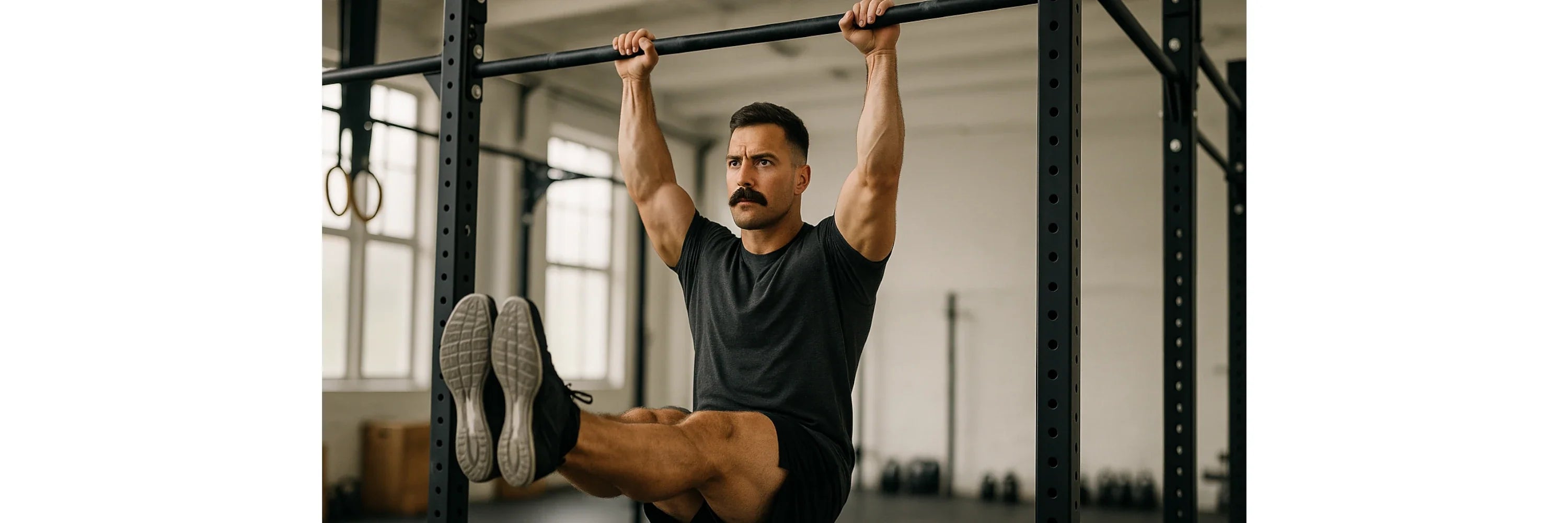
Hanging Leg Raises: This exercise effectively trains the lower abdominal muscles and simultaneously improves grip strength.
- Execution: Hang from a pull-up bar and slowly raise your stretched legs until they are at a 90-degree angle to your torso. Lower them back down in a controlled manner.
- Reps: 3 x 10–12.
L-Sit: A static exercise that requires strength and stability in the abdominal muscles.
- Execution: Sit on the floor or support yourself on parallel bars. Lift your legs straight in front of you so that your body forms an “L,” and hold the position.
- Duration: 3 x 10–30 seconds.
How an effective abdominal workout should be structured
Given the countless exercises for abdominal training, a structured scheme can be helpful.
Activation: Start with an isometric exercise, such as the plank, to activate the core muscles and prepare them for training.
Anti-movement exercises: Use exercises like the Pallof press to improve stability and resist rotation or side bending.
Dynamic exercises: Incorporate exercises like Russian twists or hanging leg raises to build strength in movement.
Full-body integration: Use complex exercises like ab wheel rollouts to train the core in conjunction with other muscle groups.
Cooldown and stretching: Conclude with stretching exercises for the spine and abdominal muscles.
Example workout:
- Plank: 3 x 30 seconds.
- Pallof Press: 3 x 12 per side.
- Hanging Leg Raises: 3 x 10.
- Ab Wheel Rollouts: 3 x 8–10.
- Cat-Cow Stretch: 2 minutes.
Through this scheme, you can ensure that all aspects of torso training are covered, from stability to dynamics.
Why high repetitions are important
The abdominal muscles are characterized by a special muscle fiber composition that makes them respond to endurance training and frequent repetitions. While other muscle groups are often trained for a few repetitions with heavy weight, the abdominal muscles benefit from higher repetition counts and constant training.
Reason:
- High proportion of type I muscle fibers: These fibers are designed for endurance and allow the abdominal muscles to remain stable for a long time.
- Constant daily strain: The abdominal muscles are activated during many everyday movements such as standing, walking, and bending, and are used to constant work.
Training approach:
- For abdominal exercises, aim for repetition counts of 15 to 20 or more per set.
- Supplement with isometric holding exercises like planks for holistic development.
Through this approach, you can train your abdominal muscles optimally and increase both their strength and endurance.
Frequency:
Perform this training 2–3 times per week, ideally at the end of your workout or as a standalone session. For advanced athletes, weights and more demanding variations can be added.
Conclusion
A strong torso is the basis for nearly every athletic performance and pain-free movement in everyday life. It not only improves your posture and stability but also protects you from injuries and increases your performance. Whether you are just starting your training or are already an experienced athlete: torso training should always be a part of your program.



