
Hip Thrust: Muscles, Technique, and Variations Explained
A strong, capable body is built on a solid foundation, and that includes the posterior chain. This chain comprises, among other things, the glutes, hamstrings, and lower back, playing a central role in stability, power transfer, and injury prevention. Despite its enormous importance, it is often neglected in training, especially compared to the anterior chain, i.e., the abdominal and quadriceps muscles. Yet a strong posterior chain is vital for many fundamental exercises like deadlifts, squats, or Olympic weightlifting. It not only provides more power in hip extension but also stabilizes the pelvis and protects the spine. One of the most effective exercises to train these specific muscle groups is the hip thrust. It allows for isolated strengthening of the gluteus maximus while simultaneously promoting the functionality of the entire posterior chain. When performed correctly, the hip thrust can not only increase athletic performance but also improve posture and body control. Anyone who executes a clean hip thrust immediately realizes how much glute power was lying dormant—and why the exercise boosts deadlifts, squats, and sprints directly.
In a nutshell
- The hip thrust is a hip extension exercise with a strong focus on the gluteus maximus and the posterior chain.
- Technique: Shoulder blades on the bench, barbell on the pelvis, explosively drive the hips upward — knees over the heels in the final position.
- Direct transfer to deadlifts, squats, Olympic weightlifting, and all movements involving explosive hip extension.
Let's get started
What is a hip thrust
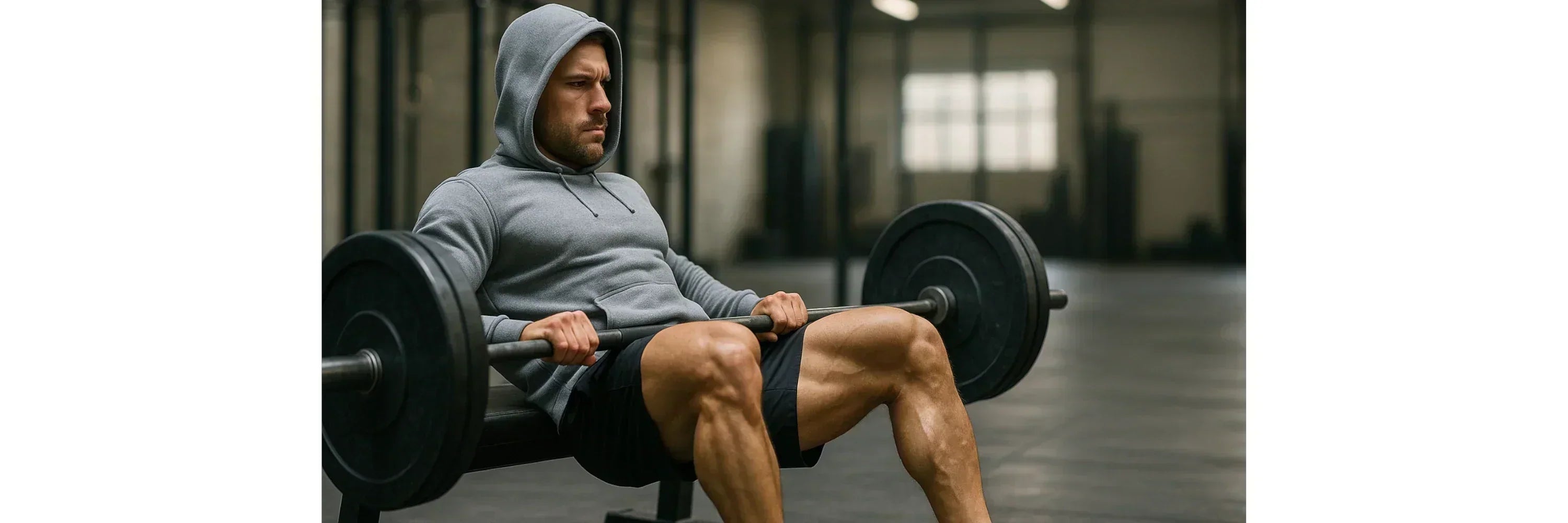
The hip thrust is an effective exercise for specifically strengthening the glutes and the posterior muscle chain. You push your hips upward against resistance. Typically, you sit on the floor and lean your upper back against a training bench, while your feet are placed flat on the ground. From this stable position, you powerfully lift your hips. To increase the training stimulus, a loaded barbell is usually placed on your pelvis. Compared to classic exercises like squats or deadlifts, the focus in the hip thrust is even more strongly on the glutes.
How to perform hip thrusts correctly
Before you can get started, a little preparation is required. You need a training bench or a stable foam roller as well as a barbell or dumbbell. Ideally, use a barbell pad to reduce the pressure on the pelvis. Sit on the floor and lean your upper back against the bench so that your shoulder blades are resting on it. The feet are flat on the floor about hip-width apart, and the barbell is positioned across your pelvis, ready for the movement.
Step-by-step
- Start with your legs bent. Your feet are flat on the floor, about shoulder-width apart, with knees pointing forward.
- Lift the hips by contracting the glutes. Push the hips upward until your torso and thighs form a straight line.
- Pause briefly at the top and squeeze the glutes maximally.
- Lower the hips slowly without letting them touch the floor completely.
Foot positioning controls muscle activation:
- Knees over the heels in the top final position: This is the standard position for maximum glute activation.
- Further forward: This engages the hamstrings more.
- Closer to the glutes: The quadriceps take over more.
The entire sole of the foot remains on the floor. Consciously push yourself upward through the heels.
Hip thrust muscles: Which ones are trained
The hip thrust is a hip extension exercise with a strong focus on the glutes and the posterior muscle chain—that is, everything that extends, lifts, and stabilizes you. The gluteus maximus is the primary working muscle in the hip thrust. It is responsible for hip extension. This muscle not only provides power but also plays an important role in posture, stability, and relieving the lumbar spine.
Supporting musculature:
- Gluteus medius and minimus: These lateral gluteal muscles help to stabilize the hip—especially in single-leg variations.
- Hamstrings: They support hip extension but are used less than in deadlifts.
- Quadriceps: The quadriceps work to stabilize the knee but are not the primary focus.
- Adductors: Activated especially when using a wide foot stance.
- Core musculature: Provides stability during the movement and protects the spine.
What are the benefits of hip thrusts
- Strong glutes: The gluteus maximus is the largest muscle in the body, and it is precisely this muscle that is specifically activated during the hip thrust.
- Increased performance: Strong hip extension helps with sprinting, jumping, and lifting.
- Improved posture: Strong glute muscles stabilize the pelvis and relieve the lower back.
- Less strain on the back: Compared to deadlifts, the pressure on the spine is significantly lower.
- Shape and aesthetics: For many, a toned, round butt is a welcome secondary goal. Hip thrusts are perfectly suited for this.
What are common mistakes
- Hyperextension of the back: Keep your neck neutral and avoid a deep arched back.
- Incorrect foot position: Check that your knees are over your heels in the final position.
- No muscle feeling: If you feel the exercise in your lower back or thighs, something is often wrong with the technique.
- Sloppy execution: Perform the movement consciously and in a controlled manner—no swinging.
Different variations for every training level
- Bodyweight hip thrust: Ideal for beginners or as a warm-up.
- Hip thrust with resistance band: Good glute activation without heavy weights.
- Barbell hip thrust: Classic and very effective for advanced users.
- Single-leg hip thrust: Increases the difficulty level and additionally trains stability.
- Feet-elevated hip thrust: With feet on an elevation for a greater range of motion.
How hip thrusts improve your Crossfit
In Crossfit, everything revolves around explosiveness, stability, and clean movement patterns. These are central capabilities of the glute muscles. The hip thrust specifically strengthens this muscle group and thereby improves many core movements that regularly occur in Crossfit. This is especially evident in Olympic weightlifting, where powerful hip extension determines whether the movement can be executed explosively and under control. The hip thrust trains this hip extension in an isolated and effective way, so that you can generate more power and move weight more efficiently at the crucial moment. Kettlebell swings also noticeably benefit from strong glutes, as the movement is likewise based on rapid hip extension. The stronger the posterior chain, the more explosive and stable the swing becomes. The same applies to box jumps: the impulse for a high, clean jump comes largely from the hips. Those who regularly integrate hip thrusts into their training plan not only jump higher but also land with more control. With wall balls, the necessary power also largely originates from hip extension. A well-trained gluteus maximus ensures that you can throw the ball at the target with more power. Even with classic lifts like deadlifts or sumo deadlifts, a strong gluteus pays off: hip extension is the critical moment during the ascent, and strong glute muscles help to lift the weight cleanly and in a back-friendly way. The effect is even clearly visible when running and sprinting. The gluteus maximus is significantly involved in forward propulsion, and those who train it specifically move more efficiently, faster, and more stably.
Conclusion
The hip thrust is far more than just a good exercise for a round butt—it is a highly effective strength exercise that specifically strengthens the gluteus maximus as well as the entire posterior muscle chain. Through isolated hip extension, it not only improves your posture and body stability but also provides concrete performance gains in Crossfit, weightlifting, running, and jumping. When performed correctly, the hip thrust is gentle on the joints, versatilely scalable, and suitable for every training level. Whether you are looking for more power for deadlifts, want to jump more explosively, or simply need a stable base for functional movements—the hip thrust belongs in every training plan designed for progress, performance, and health.



