
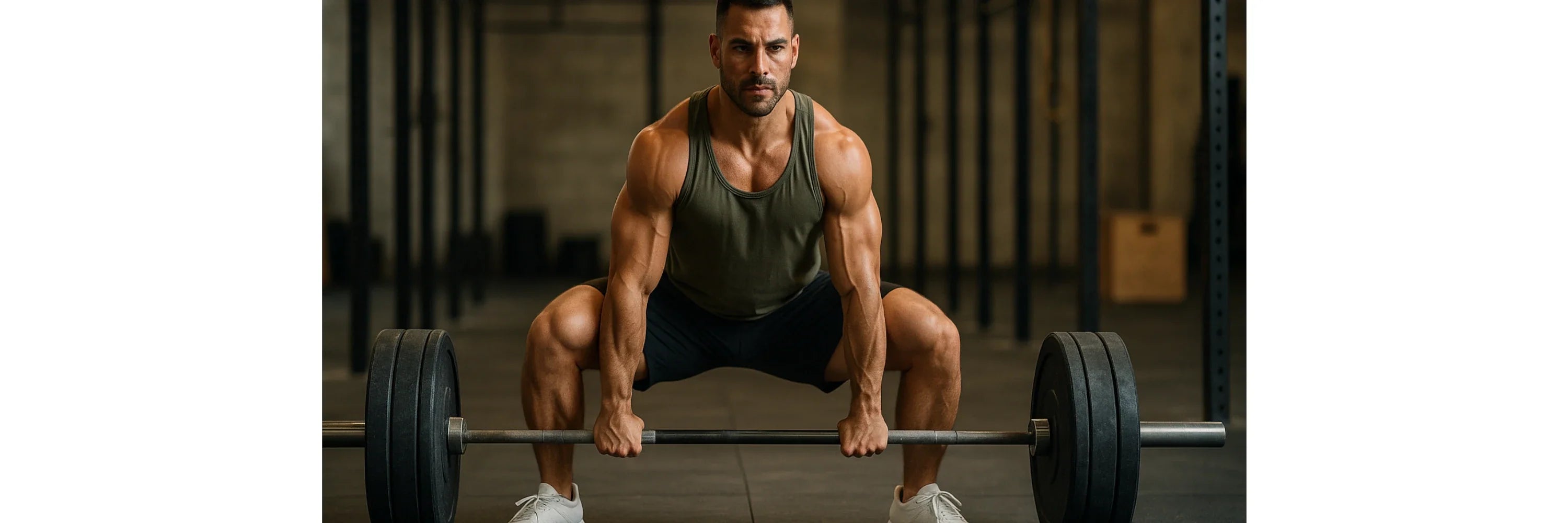
From Romanian deadlifts to sumo deadlifts
Deadlifting is one of the most fundamental and effective exercises in strength training. It is not just a test of strength, but also a must for anyone wanting to work on a strong back, powerful legs, and a stable core. In addition to the classic deadlift, there are numerous variations that emphasize different muscles more strongly and can specifically compensate for weaknesses.
The classic deadlift
The classic deadlift is the basic variation and aims to strengthen the entire posterior chain.
Starting position: Stand in front of the barbell with your feet shoulder-width apart. The bar is located directly over your midfoot. Now bend your knees until your shins touch the barbell. You are now in the perfect starting position.
Grip and posture: Grip the bar with an overhand grip or a hook grip, with your hands just outside your knees. Keep your back straight, chest upright, and core braced.
Movement: Extend your hips and knees simultaneously, pull the bar upward while keeping it close to your body, and stand up completely straight.
Return: Lower the bar in a controlled manner by pushing your hips back while keeping your back straight.
Muscles involved
- Primary: Erector spinae, gluteus maximus, hamstrings
- Secondary: Quadriceps, trapezius, latissimus dorsi, forearms
Benefits
- Ideal for building total-body strength
- Promotes stability and strengthens grip strength
- Fundamental exercise for beginners and advanced athletes
The Sumo Deadlift
This variation shifts the focus from the posterior chain more toward the hips and legs.
Stance and grip: Stand with a stance significantly wider than shoulder-width, toes pointing slightly outward. Grip the bar with your hands inside your knees.
Posture: Bend your hips and knees, keep your back neutral and your chest upright.
Movement: Extend your hips and knees and pull the bar up while keeping it close to your body.
Return: Control the downward movement by pushing your hips backward.
Muscles involved
- Primary: Gluteus maximus, adductors, quadriceps
- Secondary: Erector spinae, trapezius, forearms
Benefits
- Relieves the lower back due to a more upright posture
- Ideal for individuals with limited hip mobility
- Specifically strengthens the adductors and hip muscles
The Stiff-Leg Deadlift
The stiff-leg deadlift primarily emphasizes the hamstrings and the lower back.
Starting position: Stand shoulder-width apart in front of the bar and grip it shoulder-width apart.
Posture: Keep your legs almost straight, with your back remaining neutral.
Movement: Hinge at the hips, guiding the bar down in a controlled manner until you feel a stretch in your hamstrings.
Return: Extend your hips to bring the bar back up.
Muscles involved
- Primary: Hamstrings, gluteus maximus, erector spinae
- Secondary: Calf muscles, forearms
Benefits
- Effective isolation of the hamstrings
- Improves flexibility and mobility of the posterior chain
- Well-suited for muscle growth in the hamstrings
The Romanian Deadlift
The Romanian deadlift is similar to the stiff-leg deadlift, but with slightly more knee movement.
Starting position: Hold the barbell at hip height with arms extended.
Posture: Keep your knees slightly bent and your back straight.
Movement: Push your hips back and guide the bar down close to your body until you feel a stretch in your hamstrings.
Return: Push your hips forward to return to a standing position.
Muscles involved
- Primary: Hamstrings, gluteus maximus
- Secondary: Erector spinae, latissimus dorsi
Benefits
- Perfect for stretching and strengthening the hamstrings
- Less stress on the lower back than with the classic deadlift
- Promotes mobility and muscle control
The Snatch-Grip Deadlift
With a wide grip, this variation becomes more demanding for the upper back.
Grip and posture: Grip the bar as if you were performing a snatch. Keep your back neutral and your chest upright.
Movement: Lift the bar by extending your hips and knees simultaneously. Keep the bar close to your body.
Return: Control the movement downward.
Muscles involved
- Primary: Trapezius, latissimus, erector spinae, gluteus maximus
- Secondary: Hamstrings, quadriceps, grip strength
Benefits
- Higher activation of the upper back and grip strength
- Greater range of motion for more mobility and flexibility
- Ideal for weightlifters and pull-strength training
Deadlifting with Kettlebells or Dumbbells
This variation can be performed with one or two kettlebells or dumbbells.
Starting position: Stand shoulder-width apart, with the kettlebell or dumbbells between your feet. If you are performing the exercise with two dumbbells or kettlebells, stand about hip-width apart with the weights placed outside your feet.
Posture: Keep your back neutral and your chest upright.
Movement: Extend your hips and knees, guiding the weight upward close to your body.
Return: Lower the weight in a controlled manner.
Muscles involved
- Primary: Gluteus maximus, erector spinae, quadriceps
- Secondary: Hamstrings, trapezius, forearms
Benefits
- Easily accessible for beginners and home training
- Easier on the lower back due to more compact weights
- Promotes stability and mobility
Conclusion
The deadlift and its variations offer various benefits for both beginners and advanced athletes. Each variation has its own focus and makes you stronger in a different area. While the classic deadlift is perfect for building total-body strength, variations such as the sumo deadlift or the Romanian deadlift target specific muscle groups.



