
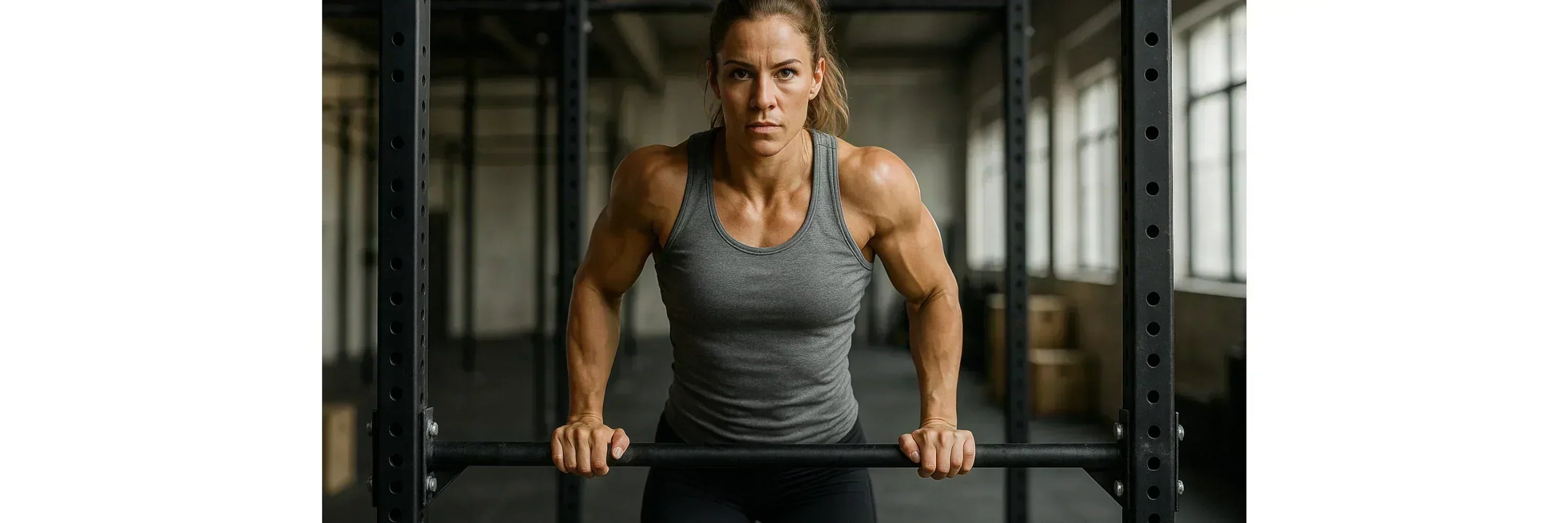
From pull-up to muscle-up and everything you need to know about it
The muscle-up is a challenging and impressive exercise often encountered in CrossFit or calisthenics. It combines the pull-up and the dip into one complex movement that requires strength, technique, and coordination. During a muscle-up, you pull your body upward using back strength, clear the bar, and then continue pushing yourself up until your arms are fully extended. Some people need years of training before they manage their first muscle-up, and even if you have mastered the exercise in theory, that doesn't necessarily mean it will work during a workout. But how do you go about learning the muscle-up and mastering the necessary technique? This article provides valuable tips and a clear overview to help you acquire this demanding movement step by step.
At a glance
Compact, clear, and easy to understand – all the information in under a minute.
- The muscle-up looks impressive and offers specific training benefits.
- Before you start training for the muscle-up, you should have mastered pull-ups and dips.
- Pulling instead of tipping is one of the most common mistakes when performing muscle-ups.
Let’s get started
What is a muscle-up
The muscle-up is a high-skill movement. Essentially, the muscle-up consists of two main components: a pull-up, where you pull yourself up on the pull-up bar, and a dip, where you then push your body upward to clear the bar and enter a full support position. The movement is not only impressive but also requires considerable body control and practice.
Are muscle-ups useful or just for show
The muscle-up is much more than just an impressive movement – it offers tangible, training-specific benefits. For one, the combination of pulling and pushing movements specifically strengthens the entire upper body musculature, especially the back, shoulders, chest, and triceps. At the same time, it promotes body control and coordination, as you must learn to move your body over the bar in a controlled manner while staying stable. Your explosive power also benefits: the muscle-up demands a fast, powerful pulling motion – a skill that can be transferred to many other athletic movements. Furthermore, it is a useful addition to your training program because it combines elements of pull-ups and dips, building functional strength that benefits you in numerous other exercises. Last but not least, the muscle-up is also a mental challenge: for many, it is an ambitious goal that creates motivation and encourages continuous improvement.
What is the correct muscle-up technique
The muscle-up may seem difficult at first, but with the right technique and a little patience, you can successfully learn it. There are a few essential points you need to pay attention to in order to perform the movement correctly.
Starting position: The muscle-up begins with the proper grip and a stable starting position. Grasp the bar with an overhand grip, about shoulder-width apart or slightly wider. It is important that you do not just hang loosely from the bar but adopt an active posture. Tighten your core, squeeze your glutes slightly, and straighten your legs so that your body remains in a straight line. Your feet should be together and pointing downward. You are now in the hollow position – your back is slightly rounded, your chest is slightly sunken, and your core is fully engaged. This posture is the basis for a stable kipping movement and ensures that you can transfer power efficiently.
Kip swing: From the hollow position, you now initiate the kip swing – a controlled swinging motion that helps you generate momentum for the muscle-up. You rhythmically alternate between two body positions: the hollow position (core engaged, legs slightly in front of the body) and the arch position (chest out, legs slightly extended behind). In the arch position, you open your body by pushing your sternum forward and pulling your feet slightly backward. Then, you actively pull yourself back into the hollow position. This swinging motion is not aimless; rather, it is a conscious sequence of body tension and relaxation controlled by your core muscles. The goal is to build a powerful but fluid swing that allows you to transition to the explosive movement in the next step.
Hip drive: As soon as your body swings backward and you are back in the hollow position, pull your legs up and use the moment for an explosive hip drive. Imagine you want to bring your hips to the bar in a powerful thrust – almost as if you were bumping your stomach against it. At the same time, begin to pull yourself actively backward and upward with your arms. This part is crucial, as many fail here because they try to pull themselves straight up. Instead, you need a backward/upward pull that brings you close to the bar and creates space for the transition. Your hips provide the impulse, and your arms immediately follow with power – the interplay of both movements creates the explosive force that carries you over the bar.
Transition: Once your hips are close to the bar and you have built up sufficient momentum, the technical crux of the muscle-up follows: the transition. Speed is required here. You quickly pull your elbows upward and forward – not to the side – and simultaneously begin to tip your torso over the bar. It feels a bit like you are swinging over the bar, similar to a forward roll. The goal is to bring your shoulders in front of the bar and move from the pull into the position for the dip. The more fluidly you execute this transition, the easier the following phase will be. Ensure that your core remains stable and that you do not arch your back.
Dip: After the transition, you are in a kind of deep dip above the bar. Your chest is over the bar, your elbows point backward, and your hands are now below your shoulders. Now you must push your body upward with strength. Push yourself up in a controlled manner until your arms are fully extended and you are in a stable position above the bar. Keep your core engaged, open your chest, and look straight ahead. In CrossFit workouts, you will often repeat this movement flow, so it is important to return to the starting position in a controlled manner – either by a clean reversal or by swinging into the next muscle-up. If the hip drive was explosive enough, the dip is very minimal due to the momentum.
How to learn the muscle-up
The muscle-up is a demanding exercise that requires good preparation and technique. If you are just starting with the muscle-up, it is important to focus on the right foundations.
Basic exercises: Before trying to learn a muscle-up, you should ensure that you have mastered the basics. This means you should be able to perform at least eight to ten clean pull-ups and dips without assistance. These exercises form the foundation for the strength you will later need for the muscle-up.
Explosive pull-ups and kipping technique: One of the most important techniques for the muscle-up is a correctly executed kip swing, where you use momentum to facilitate the transition phase. You must practice the kipping technique individually first. With kipping, you swing with your legs and hips, generating additional energy that helps you clear the bar. You can start by moving upward on the bar while swinging, without performing the full muscle-up. The goal is to learn the correct movement and thus develop the necessary momentum.
Practice the transition: Jumping muscle-ups on a low bar are perfect for practicing the transition between the pull-up and the dip. Stand under a bar that is about chest height or stand on a plyo box. Grab the bar and jump off slightly while actively pulling your elbows over the bar and tipping yourself forward. You do not use the jump for power development, but for technical support – the focus is on a clean transition.
What are preparatory exercises for the muscle-up
Kip swings: Kip swings are a fundamental preparatory exercise for every muscle-up. You practice the controlled alternating movement between the hollow and arch positions – i.e., the rhythmic tension and opening of your body on the bar. The goal is to develop a feel for momentum, body tension, and timing. Unlike free swinging, this is not about speed or distance, but about precision and control. You initiate the movement from the core – not from the legs or arms. This exercise forms the basis for the later hip drive and the explosive transition. The better your kip swings, the easier the kipping muscle-up will be later.
Kipping pull-ups: You learn how to switch from the hollow position to the arch position and generate momentum from it. The kipping pull-up also teaches you how to work as explosively as possible using hip impulse and pulling force.
Chest-to-bar pull-ups: Here, you don't just pull your chin over the bar, but try to bring your chest to the bar – or even higher. This trains the explosive pull you need for the transition in the muscle-up. The goal is to pull yourself past the bar, not just up to it.
High knees: These are an effective exercise to train your hip control, explosiveness, and core activation. They are particularly important for the muscle-up because the kipping hip drive is essentially just an aggressive, controlled hip flexion in the air. Anyone who cannot bring their hips up quickly will have difficulties with the transition. You can train high knees standing with maximum frequency, but also while hanging from a bar – there, they are even more specific because you are simultaneously training grip strength and body tension. Hanging high knees are an excellent complement to kip swings and prepare you specifically for the hip swing during the muscle-up.
Hip-to-bar: This movement simulates the hip swing during the muscle-up. You pull yourself up on the bar and try to actively bring your hips to the bar – not just your chin or chest. This builds the necessary explosiveness in the hips to enable the transition.
Transition drills: This is the technically most difficult part of the muscle-up. You can practice it in isolation, e.g., on low bars (chest height) or with resistance bands. The goal is to bring your elbows over the bar from a high pulling position (e.g., at the highest point of a pull-up) with a quick turn and tip yourself forward.
Dips on the bar: Often forgotten: the muscle-up ends in a dip, so you must also master this movement cleanly. Start with static holds above the bar, then normal dips, and finally deep dips from the transition.
Core training: Without a strong core, you will become unstable during kipping and lose momentum and control. Exercises like hollow holds, toes-to-bar, L-sit holds, or hanging knee raises build the necessary core stability you need for momentum and control.
Ring muscle-up
Once you have mastered the technique of the classic bar muscle-up, you can try the ring muscle-up. With the ring muscle-up, you have the additional challenge of working with unstable rings. This requires even more coordination and control, as you must keep the rings stable while pulling yourself over them. It can be helpful to practice the transition and the dip on a stable bar first before moving on to the rings.
Common mistakes during the muscle-up
Too little or incorrect momentum: One of the most common mistakes in the muscle-up starts with the kip swing. Many athletes swing too hesitantly or uncontrollably, failing to build enough momentum to clear the bar efficiently. This is not merely a swinging movement, but a dynamic, targeted technique. Momentum is generated by actively initiating from the core through a controlled switch between hollow and arch positions. If the kip is too weak or poorly timed, the necessary explosiveness for the subsequent hip drive and pulling phase is lacking. Therefore, it is worth training the kipping movement separately until it becomes powerful, rhythmic, and efficient.
Pulling instead of tipping: Another mistake that makes the muscle-up almost impossible is pulling straight up like in a classic pull-up. Out of habit, many try to pull themselves vertically upward, which brings their chin to the bar – but not over it. To get into the transition, you must execute the pulling movement in an arc: backward and upward. You want to bring your torso as close to the bar as possible, ideally at chest height, not chin height. Only with this slightly curved pulling path do you create the spatial prerequisite for the fluid transition over the bar.
Transition too slow: The transition – the moment you switch from the pulling to the pushing movement – is the heart of the muscle-up and at the same time the most critical point. Many make it to the bar but pause there for too long or hesitate with the next movement. The result: they lose momentum, get stuck, and have to abort. So that this doesn't happen to you, you must move lightning-fast during the transition. As soon as your hips are at chest height, your elbows must snap forward explosively, and your torso must tip over the bar. This cannot be done slowly or half-heartedly – the transition must be fluid and decisive, almost like a small jump forward. Anyone reacting too late here will lose the movement.
Incorrect elbow position: Another typical mistake manifests in the leading of the elbows. Many subconsciously pull them away from the sides of their body or let them hang passively, causing them to block themselves. To execute the transition cleanly, the elbows must be actively led forward and upward – ideally so that they stay close to the body and end up almost in a dip starting position. This conscious elbow guidance not only facilitates the transition but also ensures that you bring your center of gravity better over the bar. Arms spread out to the side, on the other hand, often lead to a sloppy, unstable execution.
Lack of body tension: An often underestimated but central aspect of the muscle-up is body tension. Without active core strength and tension in the glutes, back, and legs, you lose not only control but also efficiency. A limp, uncontrolled body cannot transfer the applied force optimally – the kip fizzles out, the transition becomes sluggish, and the dip shaky. Especially during the flight phase and the transition, a stable core is crucial to steer your torso precisely and not lose your balance. Therefore, targeted core training is part of every preparation for muscle-ups.
No clean dip stability: Even if the transition succeeds, many fail at the last step – pushing up into the dip. This can be due to a lack of strength, but also to unstable shoulders or missing technique. Especially in the deep dip position, when your chest is over the bar, you need a solid starting position: hands under the shoulders, elbows tucked, and active shoulder stabilization. Anyone who just pushes themselves up somehow runs the risk of working sloppily or arching their back. It is therefore sensible to specifically train bar dips and work on eccentric control, i.e., the ability to lower yourself slowly and stably and push yourself back up.
Lack of preparation: The last – and perhaps most fundamental – mistake is that many approach the muscle-up too early. Without sufficient strength and technique in the basic exercises, the movement quickly becomes frustrating, inefficient, and in the worst case, injury-prone. Anyone who cannot master stable kipping pull-ups or dips simply does not yet have the necessary foundation. Therefore, the muscle-up should only be integrated into training when a solid base exists – this includes at least eight to ten clean repetitions of both basic exercises as well as good body control. Anyone who takes this time will be rewarded later with a clean and injury-free movement.
Conclusion
The muscle-up is much more than a show-off exercise – it is a technically demanding combination of pull-up and dip that requires strength, coordination, and precision at a high level. Anyone wanting to master it must not only work on pure strength but above all on clean technique, body tension, and rhythm. The road to the first successful muscle-up is long and full of setbacks for many, but with a structured approach, useful preparatory exercises, and targeted technical training, the movement can be learned step by step. Whether on the bar or later on the rings: the muscle-up rewards you with a new level of body control – and a great feeling when you manage it for the first time.



