
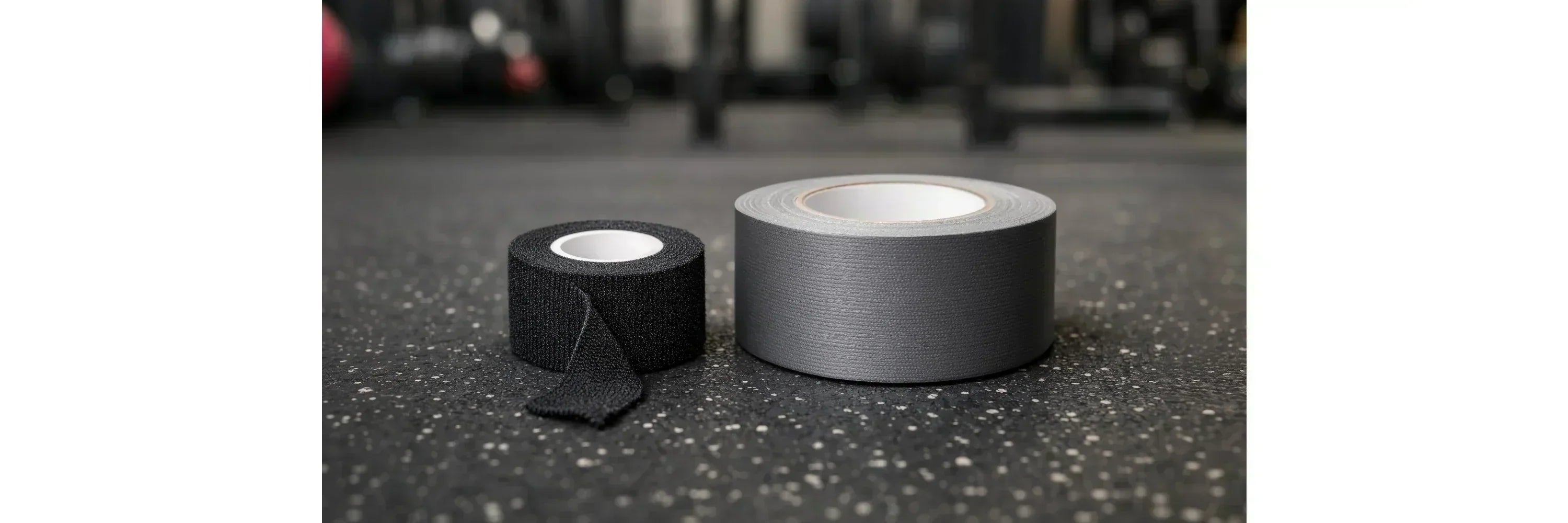
Why kinesiology tape ruins your hook grip
I see it every week at the gym: an athlete wraps blue kinesiology tape around their thumb, grips the barbell in a hook grip – and by the third clean at the latest, the tape rolls off like a party streamer. Then comes the second round: this time with the tape wrapped even tighter. The result: numb fingertips and a thumb that looks like an overstuffed blood sausage. In the next training session, they try a third variation with rigid athletic tape, so tight that the thumb joint can no longer move. The problem is not a lack of willpower or not enough tape. The problem is simpler and more frustrating at the same time: kinesiology tape was never developed for the hook grip. Sticking it on your thumb because it's called "tape" and you have it in the cupboard is about as sensible as wearing running shoes for weightlifting—theoretically, both are shoes, but the requirements couldn't be more different. But why exactly is that? What should you look for when choosing hook grip tape, and where can you get the right kind?
In a nutshell
Your advantage in just a few seconds.
- Use only hook grip tape for weightlifting. Kinesiology tape is too smooth and stretchy; rigid tape cuts off circulation and blocks the joints.
- A good hook grip is created by the mechanical interlocking of the fabric structure and a rough surface that holds chalk – not just by the adhesive strength on the skin.
- Medical tapes are often identical to expensive brand-name tape. Only invest in brand-name products if they have been specifically developed for the hook grip.
Let's get started
The physics of the hook grip
Those who start weightlifting usually believe that tape for the hook grip is just a bandage for wimps. But that is a mistake. When you wrap your thumbs with the right hook grip tape, you optimize the contact point between your hands and the barbell.
More grip through chalk: Skin and steel only get along as long as it stays dry. As soon as your hands start to sweat, you lose a massive amount of grip. Chalk helps, but unfortunately, it only stays on the skin superficially. The tape is your chalk reservoir: the rough fabric structure of the tape literally soaks up the chalk and holds it there. In effect, you are building an artificial surface that generates significantly more friction than your smooth skin ever could.
The thumb as a mechanical wedge: In the hook grip, your thumb serves as a kind of wedge that is clamped between the bar and your fingers.
The locking effect: By using an overlapping wrapping technique, you create a solid unit. The tape prevents the skin from sliding back and forth on the bone. The connection to the bar becomes more rigid – and rigid connections transfer force better than spongy ones.
Pain is a performance killer: This is where it gets psychological, but actually measurable: when the knurling of the barbell cuts directly into your nerve pathways, your body sends a stop signal. Your brain reflexively relaxes the muscles to protect you from injury. The tape serves as a pressure distributor. It absorbs the sharp points of the bar and distributes the load. Less pain means that your nervous system doesn't reduce your grip strength.
Your skin is not a wearing part: Torn patches on the thumb are not badges of honor, but a training error. If the skin tears, training is out for the next few days. Consider the tape as a protective layer: the bar rubs against the tape, not your skin. It is smarter to sacrifice the tape instead of your skin.
Why kinesiology tape is not the right choice for weightlifting
Not every tape is suitable for the extreme stresses of the hook grip. Those who reach into the shelf indiscriminately risk not only a poor grip but also numb fingers or injuries.
Kinesiology tape: It is popular in physical therapy to support movement, but it is completely out of place on the thumb.
- Too smooth for grip: The surface is designed to glide smoothly over clothing or skin. It absorbs hardly any chalk. The result: the bar simply slips out of your hand.
- The wrong kind of stretch: Kinesiology tape is extremely elastic longitudinally. During a lift, this causes the tape to stretch significantly under the load and unroll from your thumb layer by layer.
- Adhesive failure: It relies purely on chemical adhesion. As soon as sweat and chalk come into play, the adhesive dissolves and the tape becomes slippery.
Rigid athletic tape: Classic white athletic tape is often mistakenly considered a good choice because it suggests maximum stability. In practice, however, this rigidity is its greatest enemy:
- Loss of contact surface: An effective hook grip requires your thumb to be able to wrap around the bar. If you wrap your thumb with rigid tape, you block the distal thumb joint. The result: the thumb remains stiff, only touches the bar at specific points, and massively reduces the contact surface. Less contact surface means less friction, and the bar slips more quickly.
- The tourniquet effect: Rigid tape has no elasticity whatsoever. Under the massive load of a heavy lift, the pressure in the thumb tissue increases. Since the tape does not give way, it acts like a tourniquet.
- Neurological power loss: As soon as blood flow is restricted, numbness sets in. This is fatal, because for maximum force development, your brain needs precise feedback from the nerve endings. A numb thumb cannot grip in a controlled manner, and your body reduces the power output to the forearm.
Hook grip tape: Specialized hook grip tape is not a product of chance, but a targeted evolution from sports medicine. It solves the physical dilemma between stability and flexibility through a hybrid design. Hook grip tape is a targeted evolution of EAB.
- The chalk depot: The rough cotton absorbs chalk deep into its fibers. Unlike smooth skin or kinesiology tape, this creates a grippy surface that interlocks firmly with the bar – even when you are sweating.
- Perfect elasticity: The 10 to 20% stretch is the ideal middle ground: the tape wraps around the thumb firmly and stably, but leaves the joint enough leeway. This allows your thumb to nestle flat against the bar under the weight and maximize the grip surface without cutting off circulation.
- Mechanical support instead of adhesive effect: While conventional adhesive fails when exposed to sweat, the layers of this tape interlock like Velcro. This creates a solid exoskeleton that holds purely through the mechanical tension of the wraps and does not rely on adhesive strength on your skin.
- Protection increases performance: The tape distributes the pressure of the bar and protects the sensitive periosteum. Less pain prevents your nervous system from triggering a protective mechanism. You can access your full strength because your body no longer perceives the load as a threat and does not reflexively loosen its grip.
Price vs. performance: Marketing hype or real added value
This is where it becomes uncomfortable for many manufacturers: a large portion of what is marketed as specialized hook grip tape is technologically almost identical to elastic tape from medical supply stores. Often, they only differ by a fancy logo and a significant price markup.
- The price markup: For products with fitness branding, you often pay many times what a technically comparable roll costs at a medical wholesaler.
- The physics: In both cases, it is the identical material mix. However, the physical properties do not change just because a well-known label is stuck on the inside of the cardboard roll.
When the investment in brand-name tape is still worth it
However, it would be shortsighted to dismiss brand-name tapes as a waste of money across the board. There are three rational reasons why experienced athletes rely on specialized hook grip tape.
- Width: Medical tapes follow clinical standards in their width, usually 2.5 cm or 5 cm. 2.5 cm is too narrow and cuts into the skin; 5 cm is too wide for the thumb and creates annoying folds. Special hook grip tapes have a width of 3.8 cm. This is the anatomical ideal measurement to perfectly wrap the thumb between the joints. Furthermore, the thumb's fingernail remains free.
- Specialized adhesion: Inexpensive drugstore products often use acrylic adhesives that fail immediately when exposed to sweat. Hook grip tapes primarily rely on zinc oxide rubber adhesives. These are chemically designed to maintain a firm bond with the skin despite chalk, sweat, and massive shear forces.
- Handling efficiency: In training, focus is what counts. Good hook grip tapes can be easily torn off without scissors thanks to their special weave.
Conclusion
Hook grip tape is not a luxury, but a tool that measurably influences your performance. The right choice is not a matter of taste, but a physical necessity: kinesiology tape rolls off, rigid tape cuts off blood flow – both cost you kilos on the bar. Specialized hook grip tape, with its rough surface, controlled elasticity, and mechanical anchoring, solves exactly the problem it was developed for. It creates a grippy chalk surface, protects your skin from wear, and prevents your nervous system from pulling the emergency brake due to pain. The investment in specialized hook grip tape pays off: the precise width of 3.8 cm, the sweat-resistant zinc oxide adhesive, and the ability to tear it off without scissors make the difference between functional equipment and compromises. Standard medical tapes may seem similar at first glance, but the wrong measurements and inferior adhesive will cost you more in nerves than money during training.



