
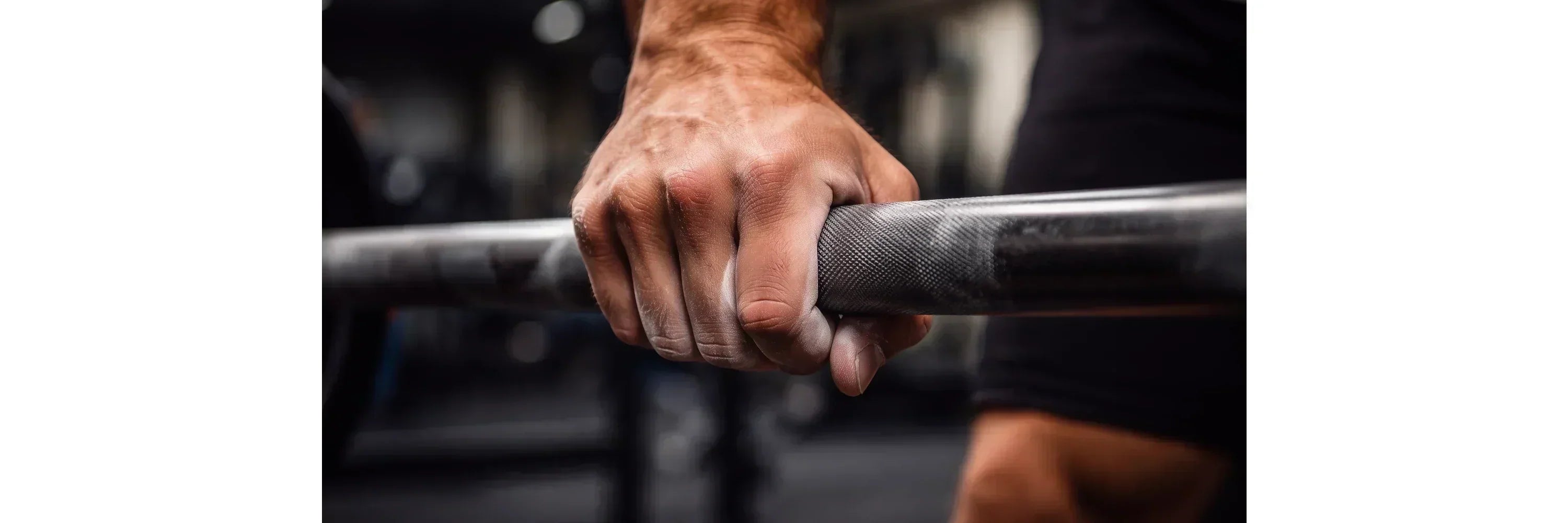
Why the hook grip works
Everyone who regularly trains with heavy weights knows that frustrating moment: Your legs are ready to push the weight off the floor with all their might, your back is stable, but your grip fails. The barbell slowly begins to slip from your fingers, even though the large muscle groups are nowhere near their limit. Grip strength becomes the limiting factor. While a standard overhand grip works fine with lighter weights, this technique quickly reaches its limits with maximum loads. The fingers simply cannot hold the barbell securely anymore. For athletes in sports like weightlifting, powerlifting, or CrossFit, this is a serious problem that directly impacts performance. That is exactly what the hook grip is for. But how does it work? What are the benefits? What is the biomechanics behind it and what are the problems associated with it?
In a Nutshell
A sip of wisdom for in between.
- The thumb is tucked between the barbell and the fingers, acting as a wedge that prevents the fingers from opening. This allows for 20-30% more grip security than a standard overhand grip.
- The thumb must get used to the load. The first few training sessions are uncomfortable, but the body adapts. Tape, progressive increases, and patience help you through this phase.
- For Olympic weightlifting, the hook grip is standard. Powerlifters and CrossFit athletes also benefit greatly from it, as the body remains symmetrical and it does not create rotational forces on the spine like the mixed grip.
Let’s get started
What actually is the hook grip?
The hook grip is also known as a thumb clamp. However, hardly anyone actually uses these terms. It is a grip technique where the thumb is first placed around the barbell and then covered by the index and middle fingers and pressed against the barbell. Unlike the normal overhand grip, where the thumb lies over the fingers, in the hook grip, it is firmly trapped—meaning the thumb lies between the barbell and the other fingers. The result is a kind of knot where the thumb acts as a safety mechanism.
The biomechanics behind it and why it works
The thumb as a mechanical wedge: In a normal grip, the thumb lies on top of the fingers and contributes only minimally to grip strength. In a hook grip, the thumb is trapped between the bar and the fingers and acts as a sort of wedge. It actively prevents the fingers from opening, even when finger muscles fatigue.
Increased friction and contact surface: The overlap of fingers and thumb creates more contact surface between the hand and the bar. The fingers press the thumb against the barbell, which increases friction and makes slipping more difficult. A type of mechanical lock is created that functions independently of pure muscle strength.
Optimized force distribution: In the hook grip, the load is distributed across multiple structures. While the finger flexor muscles must do most of the work in a normal grip, the passive tension of the thumb structures is also utilized in a hook grip. The system is mechanically more efficient.
Reduced leverage: The grip around the bar is more compact, and the distance between the hand and the center of the barbell is minimized. This reduces the torque acting on the fingers and makes the grip more stable.
The hook grip compared to other grip techniques
To understand the unique features of the hook grip, it is worth looking at alternative grip techniques:
Double Overhand Grip: The classic overhand grip. Both palms face the body, and the thumbs lie over the fingers. This is the most natural and symmetrical way to grip, but also the weakest. Grip strength is the clear limiting factor here. Advantage: Symmetrical, no rotational forces on the spine, easy to learn.
Mixed Grip: One hand is overhand, the other underhand. This prevents the barbell from rolling out of the hands because it is blocked in both directions. The mixed grip is very strong and is frequently used in powerlifting for deadlifts. Disadvantages: Asymmetrical load leads to rotational forces on the spine, increased risk of bicep injuries, and can lead to muscular imbalances.
Straps: Belts that are wrapped around the barbell, completely eliminating the need for grip strength. Maximally effective for training the pulling muscles, but usually not allowed in competition and they prevent the improvement of grip strength.
Hook Grip: It offers significantly more grip security than the double overhand grip, but remains symmetrical and avoids the disadvantages of the mixed grip. In Olympic weightlifting, it is the only viable option for the fast, explosive movements of the snatch or clean & jerk.
What are the benefits of the hook grip?
The technique offers several decisive advantages that make it the preferred choice for many athletes:
Superior grip security: The hook grip allows you to hold significantly heavier weights than with a normal overhand grip. The mechanical lock makes the grip more reliable than pure muscle strength.
Symmetrical loading: Unlike the mixed grip, both halves of the body remain symmetrically loaded. There are no rotational forces on the spine, which leads to healthier movement execution in the long run and reduces the risk of injury.
No barbell rolling: The barbell cannot roll out of the hands because it is blocked in both directions – similar to the mixed grip, but without its disadvantages.
Competition-ready: Allowed in all strength sports disciplines; no additional aids are needed. For weightlifters, it is the only safe option for explosive pulling movements.
Improved body posture: Because the grip is so secure, athletes can focus better on the actual exercise execution without having to constantly think about their grip strength.
Development of true grip strength: Unlike lifting straps, the hook grip promotes the development of grip strength, even though it provides mechanical support.
What are the disadvantages of the hook grip?
As effective as the hook grip is, it has one decisive disadvantage that scares off many athletes: It is extremely uncomfortable or even painful at the beginning. The thumb is not designed to be trapped with hundreds of kilograms. Especially the skin on the thumb, the thumb joint, and the nerve pathways initially react with clear pain signals. However, these complaints are normal and temporary. The body adapts: The skin on the thumb becomes thicker and more resilient, similar to calluses on the palms. The nerve pathways get used to the pressure and send weaker pain signals. The structures in the thumb joint become more robust and tolerate the load better. The psychological barrier drops – what initially seems unbearable becomes normal. This adaptation process typically takes a few weeks with regular training. The first training sessions are the worst, and it gets continuously better after that. It is important to understand: The pain is not a sign of an injury, but part of the adaptation process. Those who persevere through this phase are rewarded with a significantly stronger and more secure grip.
How to get used to the hook grip
Progressive entry: Do not start with maximum weights. First, integrate the hook grip during lighter warm-up sets and work your way up slowly. This gives the thumb time to adapt without overloading it.
Frequency over intensity: It is better to use the hook grip frequently with moderate weights than rarely with very heavy ones. Several training sessions per week with the hook grip significantly accelerate the adaptation.
Use hook grip tape: Many athletes wrap their thumb with special hook grip tape. This protects the skin, reduces friction, and can alleviate initial pain. Using tape in weightlifting brings further advantages.
Consider hand size: People with small hands and thick fingers find the hook grip the most difficult. This requires a little more time to get the hang of it.
Who is the hook grip useful for?
The hook grip is not equally relevant for everyone. However, if you regularly practice weightlifting, there is no way around it.
Weightlifting: Absolutely indispensable. Clean, snatch, and all associated variations require the hook grip for maximum safety and performance. Serious weightlifting is hardly possible without the hook grip.
Powerlifting: Highly recommended, especially for deadlifts. The hook grip offers a safe alternative to the mixed grip and avoids its disadvantages. Many elite powerlifters use it successfully, even if the mixed grip is more common.
Crossfit/Functional Training: Highly relevant. Many CrossFit workouts include weightlifting movements and high-volume pulling exercises. The hook grip significantly improves performance and safety.
Strongman athletes: Useful in specific situations. For some events like deadlifts, the hook grip is advantageous, while for others, lifting straps are allowed or other grip techniques are more suitable.
Hobby strength athletes: It can be useful if you regularly do heavy deadlifts or pulling exercises and want to improve your grip strength. For occasional training with moderate weights, the adaptation phase might not be worth the effort.
Bodybuilders: Less relevant. The primary goal is muscle growth, and lifting straps eliminate grip strength as a limiting factor more efficiently. The hook grip offers no decisive advantage here.
Conclusion
The hook grip is a biomechanically brilliant solution for one of the most fundamental problems in strength sports: limiting grip strength. Through the clever use of the thumb as a mechanical anchor, this technique turns a weak grip into an extremely secure and resilient one. It works through increased friction, optimized force distribution, and mechanical locking. It offers the grip security of a mixed grip without its disadvantages and is significantly stronger than a normal overhand grip. It is indispensable in weightlifting and a valuable addition for many other strength athletes. However, the price for this effectiveness is a somewhat uncomfortable adaptation phase. The thumb must learn to withstand loads it was not primarily designed for. This phase lasts a few weeks and requires perseverance. But those who invest this time are rewarded with a grip that functions reliably for years and measurably improves athletic performance. The decision for or against the hook grip depends on your athletic goals. If you perform heavy pulling movements, compete in tournaments, or no longer want your grip strength to be your limiting factor, the investment is definitely worth it. The first few weeks may be hard, but the result is a grip you can rely on even with maximum loads. The hook grip isn't always comfortable. But it works. And sometimes that is exactly what counts.



