
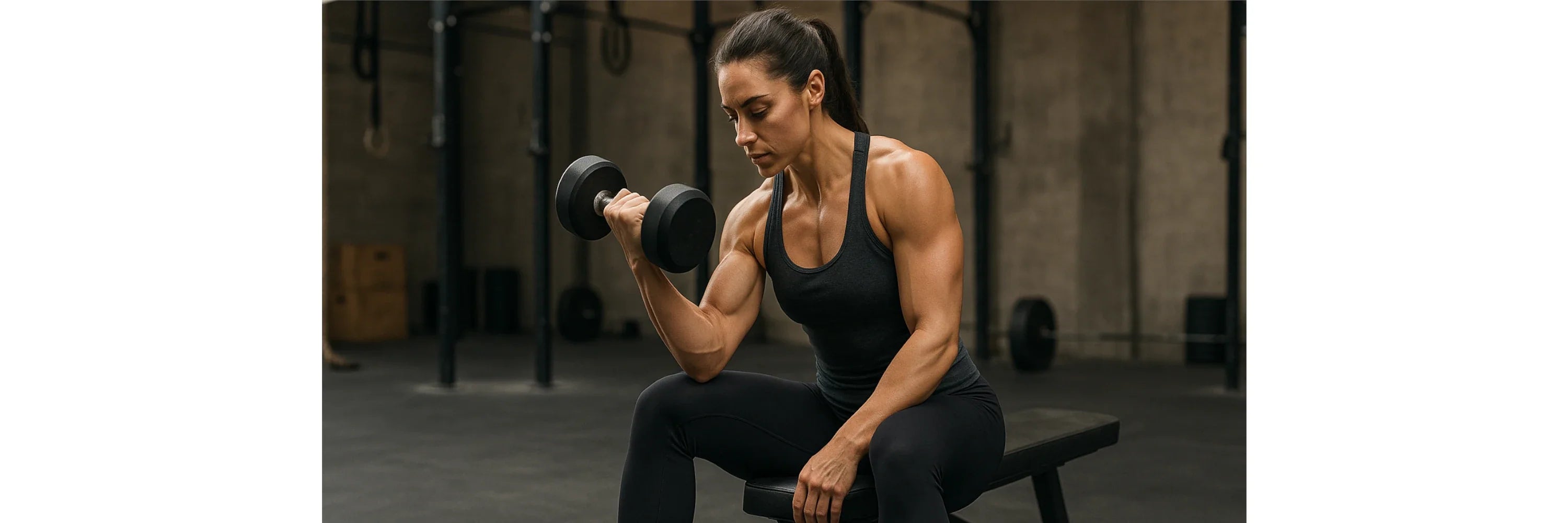
Range of Motion: Meaning, range of movement, and benefits
Strength training is often all about training plans, weights, repetitions, and sets. However, one crucial factor is frequently overlooked: the range of motion (ROM) – the extent to which you perform an exercise. This very range of motion determines how much muscular stimulus you get out of every single repetition. Those who understand and consistently utilize it train more effectively, with better form, and with a lower risk of injury.
In a nutshell
Like an EMOM for your brain – compact and effective.
- Range of Motion refers to the extent of movement in an exercise.
- A full range of motion activates more muscle fibers, generates more tension, and is more effective for muscle building.
- Partial repetitions can be useful – but they are no substitute for clean training through the full movement.
Let’s get started
What does Range of Motion (ROM) mean?
Range of Motion (ROM) refers to the full extent of movement – also known as the range of the movement or movement amplitude. The term describes how far a joint or a movement can be taken in a specific direction: for example, how deep you go into a squat or how far you reach your arm overhead. The greater the range of motion, the more your muscles are stretched and contracted during a repetition.
What is meant by Full Range of Motion
When you perform an exercise using a full range of motion, you are utilizing the entire movement potential of a joint or muscle chain. This involves maximally stretching the muscle and then contracting it completely.
Squat: Full ROM means going at least below parallel, meaning your hips are lower than your knee joint.
Bench Press: The barbell lightly touches your chest before you press it back up – instead of only working in the top half of the movement.
Bicep curls: The arm is fully extended and then controlledly curled – not just through the last third of the movement.
Why is Full Range of Motion important for muscle building?
Maximum muscle stretch and contraction: Strength training is about stimuli. The stronger the stimulus on the muscle, the greater the adaptation. A full ROM ensures the muscle works through its entire length. This combination of maximum stretch and maximum contraction is ideal for hypertrophy.
Increased mechanical tension: Mechanical tension is one of the most important factors in muscle growth. The longer and more controlled a muscle is under tension, the greater the growth stimulus – and that is exactly what a full range of motion provides.
Greater muscle activation: If you only perform a partial movement, part of the muscle remains idle. With a full ROM, more muscle fibers must be activated, particularly in the stretched positions, which are especially conducive to growth.
Technique, stability, and injury prevention: Exercises performed through a full range of motion improve your movement control and joint stability. You train not only isolated muscles but also tendons, ligaments, and smaller stabilizers. This makes you more resilient to injuries in the long term – both in training and in everyday life.
What happens if you only train with partial movements?
Partial repetitions can be used effectively in training. A typical example is bench pressing in powerlifting: sometimes only the final centimeters of the movement are trained to strengthen the lockout. However, for muscle building, this approach is usually less effective than training with a full range of motion. This is because, with a full range of motion, the musculature is activated over the entire path of movement, which means: more muscle tension, more stimulus, and a better growth signal. Comparing the two approaches in detail:
- Muscle activation is significantly higher with a full ROM because the muscle works through its entire length. With partial movements, a portion of the muscle often remains inactive.
- The signal for muscle growth is stronger with a full ROM. While partial repetitions can trigger this in certain cases, they are less efficient.
- In terms of technique, a full ROM helps in learning clean and stable movement. Partial movements carry the risk of developing poor movement patterns.
- The risk of injury is also lower when performing movements cleanly through the complete range – especially with complex compound exercises.
- The area of application also differs: Full ROM is optimal for muscle growth, mobility, and functional strength. Partial movements are more useful in advanced strength training or specializations like powerlifting.
How to integrate Full Range of Motion into your strength training
Prioritize technique over weight: Choose a weight that allows you to work cleanly and under control through the full ROM – without cheating or cutting corners. It is better to lift 60 kg with a full ROM than 80 kg half-heartedly.
Integrate pauses at the bottom of the movement: Pause reps (e.g., 1–2 seconds at the lowest point of a squat) ensure more stability, muscle tension, and control.
Work on your mobility: Limited flexibility often prevents a clean full ROM – e.g., in the ankles, hips, or shoulders. Take time regularly for mobility workouts to improve your ability to train in the long run.
Use helpful accessories: Heel wedges, weightlifting shoes, or resistance bands can help facilitate clean movement patterns until your mobility is sufficiently improved.
Conclusion
The range of motion (ROM) is an important but often underestimated factor in strength training. Performing exercises through a full range of motion activates more muscle fibers, generates higher mechanical tension, and ensures more effective muscle development. It also improves technique, stability, and protects against injuries in the long term. Partial repetitions have their place, but they should be used specifically and as a supplement. Anyone who wants to become stronger and more muscular in the long term should consistently integrate the full range of motion into their training – supported by good technique, mobility work, and proper equipment.



