
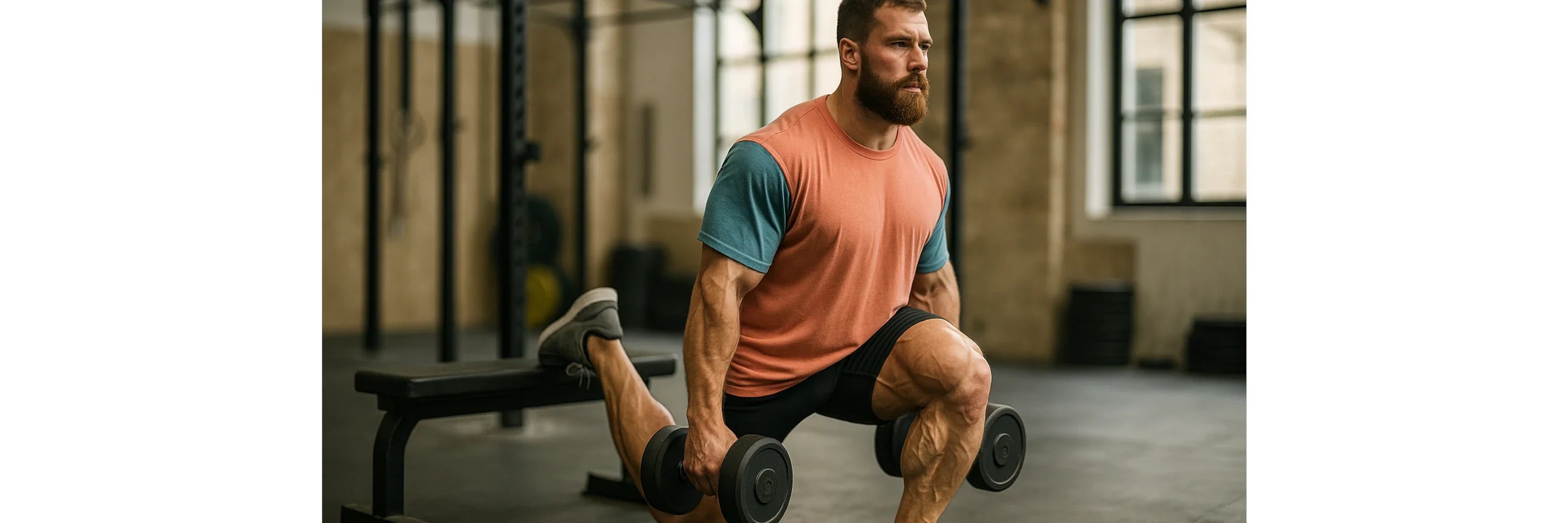
Bulgarian Split Squats: single-leg squats & execution
Anyone trying Bulgarian split squats for the first time will quickly notice: this exercise looks harmless, but it packs a punch. After just a few repetitions, the thighs burn, balance becomes shaky, and the next day you are hit with a serious case of muscle soreness. It is no wonder, then, that the one-legged squat and its variations can be found in the training plans of many professional athletes. One of them is track cyclist Robert Förstemann, whose thighs are almost world-famous for their immense circumference. He also helped the exercise gain popularity in the wider training world. Even if you don't have legs like Robert Förstemann yet, Bulgarian split squats are an excellent exercise to specifically build leg and glute muscles, correct muscular imbalances, and at the same time significantly improve your core stability. In this article, you will learn the correct execution step by step, which muscle groups are involved, the most important variations, and the most common mistakes you should avoid.
In a nutshell
Minimal effort, maximum benefit – what you need to remember.
- The Bulgarian split squat primarily trains the quadriceps.
- The knee should remain behind the toes throughout the entire movement.
- 80–90% of the load should be on the front foot.
Let’s get started
What are Bulgarian split squats
Bulgarian split squats are a one-legged squat – also called a split squat or single-leg squat – where the rear leg is placed on an elevated surface like a bench. You squat with the front leg while the rear one only provides stabilization. This shifts the majority of the load specifically onto one leg, which makes the exercise particularly intense.
The perfect execution of Bulgarian split squats
Before you get started with Bulgarian split squats, you need a little preparation for the correct setup. You will need a stable, knee-height elevation on which you can place your rear leg during the exercise. A training bench, plyo box, or a sturdy crate is suitable for this. Make absolutely sure that the surface is stable and does not wobble so that you can train safely. Position the bench or box at a distance of about one large step behind you. Only when the setup is right can you focus on clean and safe execution.
Now for the actual execution:
- Place the barbell on your neck as if you were doing back squats.
- Stand about one step in front of the training bench with the weight on your neck.
- Place the instep of your rear foot on the bench.
- Tighten your core and keep your upper body upright.
- Lower your body slowly by bending the front leg.
- Make sure that your front knee does not protrude beyond your toes.
- Go down until your front thigh is approximately parallel to the floor.
- Push yourself back up in a controlled manner using your front leg.
- Then repeat the same for the other leg.
Which muscles are trained with Bulgarian split squats
Bulgarian split squats are a multi-joint exercise that targets several muscle groups at the same time.
- Quadriceps (front thigh) – primary work
- Gluteus maximus (glutes)
- Hamstrings (back of the thigh)
- Adductors (inner thighs)
- Calf muscles
- Core muscles
Benefits of Bulgarian split squats
Unilateral training: You train each side of your body individually – ideal for identifying and compensating for imbalances.
More stability and balance: Because only one leg is working, the body has to compensate for a lot – this improves your coordination and core stability.
Highly effective: Even with little or no weight, the exercise yields quickly noticeable progress.
Knee-friendly with proper technique: Executed correctly, Bulgarian split squats are gentle on the knees and back and can prevent knee pain – as long as the front knee stays over the foot. Compared to heavy barbell squats, the load per leg is easily manageable.
Variations of Bulgarian split squats
- Bodyweight: Without additional weight
- Dumbbell: With a dumbbell in both hands
- Kettlebell: With kettlebells in your hands
- Barbell: With a barbell on your neck
- Smith machine: Same execution as with a barbell, but significantly less balance required.
- Tempo variations: For example, lower for 3 seconds, hold for 1 second, stand up for 1 second
- Pulsing reps: Small repetitions in the lowest range
Common mistakes – and how to avoid them
When performing Bulgarian split squats, small but crucial mistakes can easily creep in. One of the most common is the front knee pushing too far forward when lowering and protruding beyond the toes. This puts unnecessary strain on the knee joint and can be easily avoided by placing your front foot a bit further forward and consciously ensuring the knee stays over the foot. Another typical mistake is the torso collapsing. Many people tend to lean forward while lowering. This comes at the expense of technique and core stability. Therefore, make sure to actively tighten your core and keep your upper body upright without arching your back. The distance to the bench also plays an important role: if you stand too close, the movement becomes uncomfortable for the front knee and tight in the hip. If you stand too far away, your balance suffers and tension in the target muscle is lost. A good guideline is about one large step distance between you and the elevation. Finally, many people subconsciously do too much work with the rear leg. The load should be 80–90% on the front foot. The rear leg only serves for stabilization and should not actively push you upward.
Tips for better Bulgarian split squats
- Less is more: Clean execution is more important than many repetitions or heavy weight.
- Proper warm-up: Mobilize your hips, knees, and ankles before training.
- Stable stance: Pay close attention to a stable stance. The higher the weight, the more important this is.
Conclusion
Bulgarian split squats are an excellent exercise when it comes to building strength specifically in the legs and glutes. Due to the one-legged execution, not only is the musculature intensely engaged, but your coordination, balance, and core stability are also significantly improved. This combination makes the exercise not only effective but also functional, meaning it carries over directly into everyday life, sports, and other forms of training. A major advantage is the unilateral loading: you identify and correct muscular imbalances between the left and right sides of your body, which prevents injuries in the long term. At the same time, the movement forces you to be in control – poor technique is immediately apparent here, which automatically makes the execution more mindful. The exercise requires concentration, body tension, and patience. Anyone who trains this regularly will not only become stronger but also develop better body awareness and more control over their movement.



