
Making muscle building more efficient: How to use eccentric strength training effectively
When we move weights in the gym, do push-ups, or hammer out squats in the CrossFit box, we rarely think about what is actually happening in the body. A repetition is just a repetition, right? Not quite. Because every movement in strength training, whether with a barbell, on the pull-up bar, or with your own body weight, consists of two different phases: the concentric and the eccentric phase. And both have different effects on your musculature, your strength, and your training success. But what exactly is the deal with these two phases? Is one more important than the other? How do you use them to your advantage?
In a nutshell
For those in a hurry with high standards – the most important points at a glance.
- Every movement consists of two phases.
- Don't just drop the weight during deadlifts in training.
- Executing the eccentric phase slowly ensures more muscle mass.
Let’s go
What do "concentric" and "eccentric" actually mean?
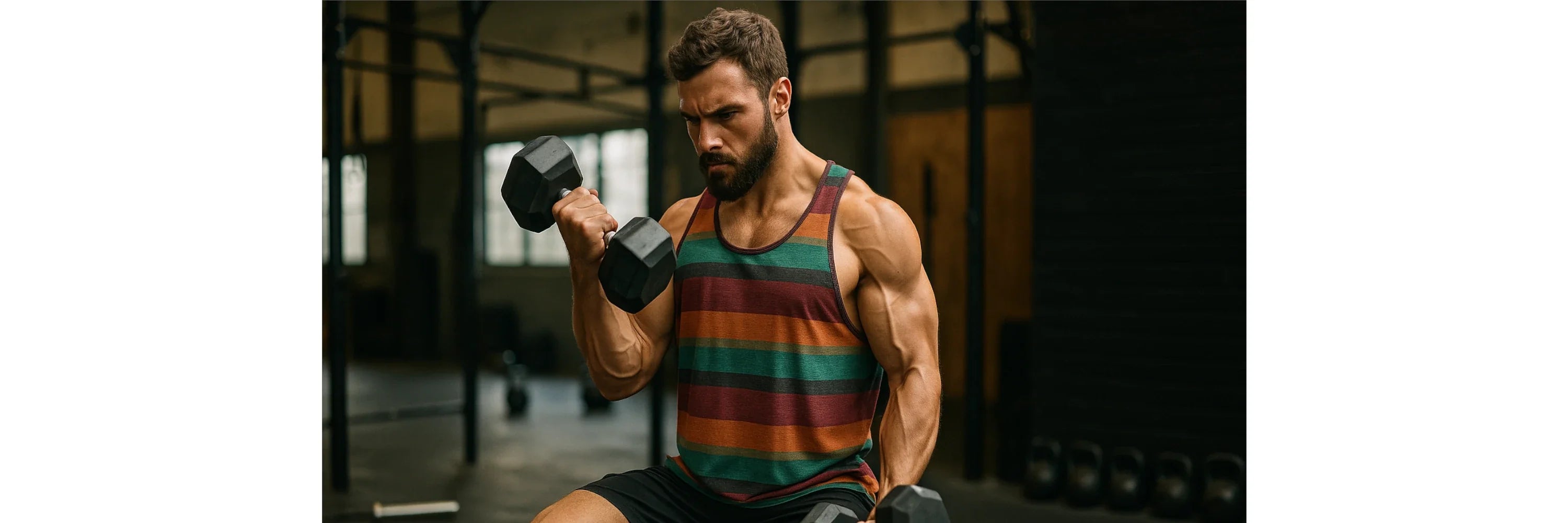
Admittedly, the terms sound pretty technical at first. But once you understand what they mean, you will recognize them in every exercise. The concentric phase is the part of the movement in which your muscle shortens. You actively apply force to move a weight or push yourself up against gravity. A classic example: In a bicep curl, the concentric phase is the pulling up of the dumbbell as the muscle contracts. Or in a push-up, it's pushing your body up from the floor. Or in a squat, it's standing up from the deep squat position. The eccentric phase, on the other hand, is the controlled return to the starting position, during which your muscle lengthens under tension. For the curl, this is the slow lowering of the weight. For the push-up, it is lowering down to the floor. For the squat, it is the controlled descent into the squat. Both phases are part of every repetition. But often, too little attention is paid to the eccentric phase. Yet it is a key stimulus for muscle growth.
Why the eccentric phase is important for muscle building
Imagine you lift a barbell powerfully from the floor and then just let it drop to the ground. You have trained the concentric part of the movement, but the second half of the exercise remains completely unutilized. And it is exactly in this phase that there is enormous potential that many people unconsciously throw away. The eccentric movement, i.e., the controlled lowering of a weight, creates a particularly high level of mechanical tension in the muscle, often even more than during the lifting phase. At this moment, your muscle fibers are actively working against the weight, braking the movement rather than accelerating it. This creates targeted micro-tears in the muscle tissue, which are by no means harmful but intended. They signal the body to build muscle. What many do not know: in the eccentric phase, we can control more weight than we can move concentrically. At the same time, energy consumption is lower, which makes this type of load particularly efficient and effective for training. Especially in CrossFit, however, one often sees how this potential is wasted. A typical example: in deadlifting, the weight is lifted cleanly from the floor and then just dropped. Sure, for the last repetition of a WOD when every second counts, this is understandable. But in strength training or technical lifts, it means: you are leaving valuable training stimuli on the table.
The concentric phase
Of course, the concentric phase is no less important. This is where your active strength unfolds. In other words, the ability to move a weight, to accelerate the body, to start explosively. This is crucial, especially in functional training and CrossFit. In exercises like the snatch, the clean & jerk, or thrusters, it is the concentric phase where you really have to deliver. It challenges your nervous system, your explosive power, and your coordination. Those who are strong but slow are often left behind in dynamic workouts. The concentric phase is therefore the performance-oriented half of the movement – the eccentric is the building half.
Why you should pay attention to both phases
Effective strength training that aims for muscle building, performance, and injury prevention should consciously take both phases into account.
The eccentric phase helps you:
- Build more muscle mass
- Control movements better
- Improve your technique
The concentric phase ensures:
- That you get stronger
- Become more explosive and faster
- Reach your full strength potential
How to correctly incorporate both phases into your strength training
To train the eccentric phase in a targeted manner, a simple but effective adjustment is often enough: work with tempo instead of momentum. Many repetitions are ripped through quickly. But it is precisely the conscious slowing down that often provides the decisive stimulus for muscle growth and control.
An example:
Instead of ten brisk squats, try performing six repetitions at a controlled tempo:
- 3 seconds lowering
- 1 second pause in the deep position
- 1 second standing up powerfully
This method, also known as tempo training, increases "time under tension," which is the duration your muscle is actively working. This exact tension is one of the most effective stimuli for muscle growth. This can also be well incorporated into CrossFit. Although Metcons are often about speed and repetition counts, you can work specifically on eccentric control during preparation, skill training, or accessory work.
- Pull-ups with a consciously slow descent
- Push-ups with a three to five-second eccentric phase
- Negative squats, where you move slowly into the depth
While control is the priority in the eccentric phase, the concentric phase is about explosiveness and strength development. Anyone who just pushes up somehow is wasting a lot of potential. The goal is to perform the concentric movement as powerfully as possible.
An example:
For a squat, this means an explosive, clean push off the floor after the controlled descent into the squat. Not shaky, not half-hearted, but with full body tension.
Explosive power can also be trained consciously:
- Speed work with lighter weight, moving about 60% of your 1RM with maximum acceleration
- Jump squats or explosive push-ups as a supplementary exercise
- Set a contraction focus; consciously feel which muscle is working during the upward movement
Conclusion
Building strength and muscle mass is more than just pumping weights. It is about how you move while doing so. Anyone who understands that every exercise consists of a concentric and an eccentric phase can make their training targeted and more effective. The often-underestimated eccentric phase in particular offers enormous potential for muscle growth, technique improvement, and body control. Through conscious, slow movements and targeted tempo training, you increase the load on the musculature and set the exact stimuli necessary for progress. For sustainable success in strength training, the rule is: use both phases of a movement consciously and train with your brain, not just with strength.



