
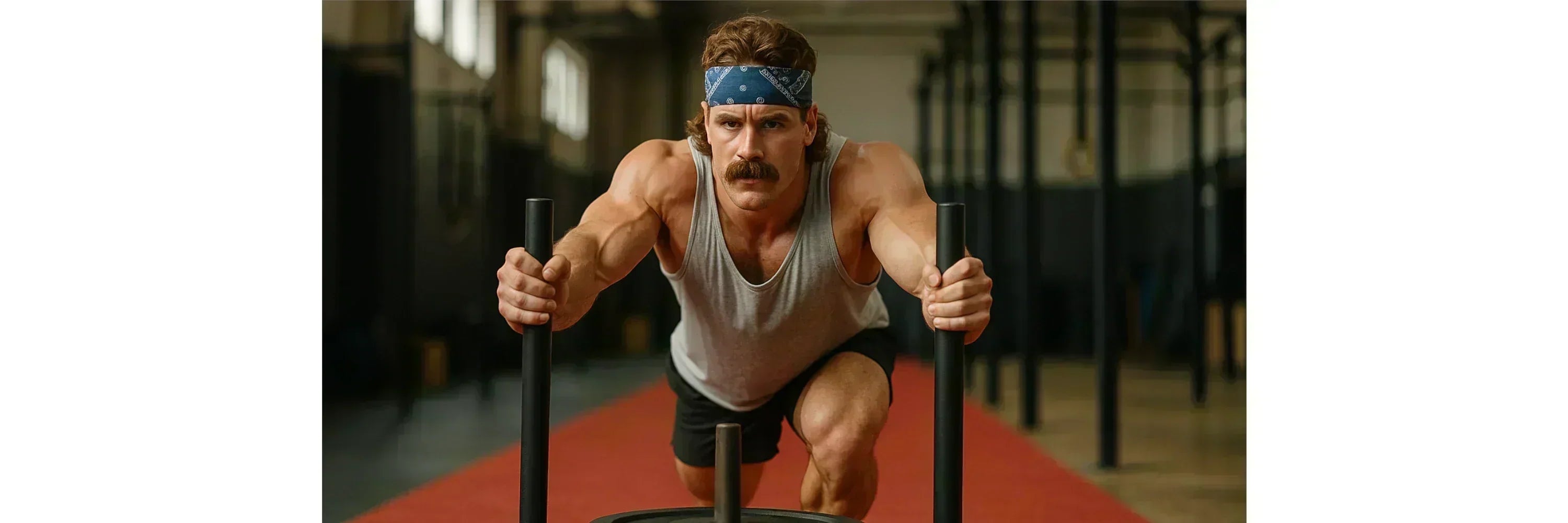
Sled Push: Technique, Muscles, and Hyrox Preparation
The weight sled, also known as a power sled, competition sled, or prowler, has become an indispensable training tool in recent years: whether in high-intensity Hyrox competitions, American football training, or at CrossFit gyms. This seemingly simple device is revolutionizing the way we train for strength, speed, and endurance. At its core, a weight sled consists of a metal platform with rails onto which weight plates can be loaded. Depending on the exercise variation, the sled is pushed or pulled using handles or ropes. What appears relatively simple at first glance is, in reality, a highly effective training tool that combines functional strength with metabolic conditioning. But what is the ideal technique? Which muscle groups are engaged, and what are the benefits of pushing a weight sled around?
In a nutshell
The quick facts.
- Because it involves exclusively concentric muscle action without a lowering phase, there is significantly less muscle soreness and muscle damage, while still providing a high training stimulus.
- Sled pushes and pulls do not train isolated muscles, but rather complex movement patterns that challenge the legs, core, and upper body simultaneously.
- With simple adjustments to weight, distance, and speed, various training goals can be achieved.
Let’s get started
How sled pushes and pulls originated
The roots of sled training go back a long way. Originally, strongman athletes used heavy objects like cars, trucks, or improvised sleds to develop their raw strength. The pushing and pulling of heavy loads has also always been used in military training to prepare soldiers for the extreme demands of deployment. In the 1990s and 2000s, the fitness industry recognized the enormous potential of this form of training. Manufacturers developed specialized sleds with various handles and optimized rails for different surfaces. This training became more well-known with the rise of functional training methods and CrossFit. Its breakthrough into the mainstream likely occurred with the meteoric success of Hyrox, where the sled push and sled pull are central components of the sport. Today, the weight sled is an essential part of any modern high-performance center.
What types of weight sleds are there
Compact mini-sleds: These light, flat sleds are ideal for quick pulling and sprinting exercises. Due to their small size, they are easy to transport and require almost no space—perfect for home gyms or outdoor sessions.
- Advantages: high mobility, good for speed and technique training, affordable entry point
- Use: acceleration, sprint power, and technique work
- Advantages: all-round use, robust, versatile
- Use: pushing, pulling, strength and conditioning training
Competition sleds: These massive models are designed for heavy loads and are often modeled after standard dimensions used in competitions like Hyrox. They run stably, offer large weight capacities, and are designed for maximum durability. If you are training specifically for competitions or want to move a lot of weight, this is the right choice.
- Advantages: maximum stability, high load capacity, realistic competition conditions
- Use: Hyrox training, strength testing, heavy push and pull workouts
Speed sleds: These extremely light and narrow sleds usually have a triangular or arrow-shaped base. They minimize contact with the ground and thus friction, which enables fast sprint pulls.
- Advantages: very low friction, ideal for sprint and acceleration work
- Use: athletics, sprint training, speed development
Drag sleds: A very simple model: a flat plate or frame with an attachment point for a pulling harness, without poles or handles for pushing.
- Advantages: inexpensive, lightweight, space-saving
- Use: pulling work, hip strength, conditioning, outdoor training
Wheel sleds: This version has wheels and operates using mechanical resistance (e.g., magnetic or air resistance). This keeps the resistance constant regardless of the floor surface.
- Advantages: indoor-compatible, reproducible resistance
- Use: gyms without turf, technique training, endurance
Modular systems: These sleds are designed for maximum variability and can be adapted to the desired conditions: various anchor points for ropes, hip belts, battle ropes, or even rotation modules.
- Advantages: extremely versatile, also suitable for lateral or rotational movements
- Use: athletic training, functional training, team sports
Weight sleds with plastic rails: An intermediate form between classic metal sleds and speed sleds: plastic rails reduce friction and noise and protect the surface.
- Advantages: quieter, smoother gliding, indoor-friendly
- Use: functional fitness, home gyms, indoor turf
Prowler-type sleds: A very common type in football and athletic training. The wide base provides plenty of stability when pushing, and the posts can be switched depending on the grip height.
- Advantages: stable, heavy loads possible
- Use: strength development, sprint power, team sports
Which muscle groups are trained during a sled push
Sled training is a full-body workout par excellence. Depending on the exercise variation, different priorities are set, but the following muscle groups are practically always involved:
Lower body: The quadriceps, glutes, hamstrings, and calves do the heavy lifting in all pushing and pulling exercises. Continuous tension over the entire movement distance provides an enormous training stimulus.
Core muscles: The core must transfer power from the legs to the sled while simultaneously stabilizing the body. This functional core strength carries over directly into everyday movements and other sports.
Upper body and shoulders: When pushing, the chest, shoulders, and triceps stabilize the arm position. When pulling, the back, biceps, and rear deltoids work intensively.
Cardiovascular system: Depending on weight, speed, and rest periods, you can train both anaerobic performance and aerobic endurance. Heavy, short sprints develop explosive power, while longer distances with moderate weight improve metabolic conditioning.
A special benefit: Sled training builds functional strength that translates directly to athletic performance and everyday movements. You are not training isolated muscles, but complex movement patterns.
Exercises with the sled and the right technique
Sled Push
Execution: This depends on exactly what you want to train and what kind of sled you have available. Variant 1: Place your hands on the handles at shoulder or chest height. Lean forward slightly so that your body forms an angle of about 45 degrees to the ground. The back remains straight, the core is engaged. Push off powerfully with your legs and push the sled forward in controlled, powerful steps. Variant 2: Lean forward as far as possible so that your upper body is nearly parallel to the ground. Then grip the sled’s handles as low as possible and lean your shoulders against the handles. Now push the sled forward using leg power. In both variants, it is important to push the sled forward rather than pushing it into the ground.
Common mistakes: body posture too upright, rounded back, steps too small, arms extended, sled being pushed into the ground instead of pushed forward
Sled Pull
Execution: Attach a rope or harness system to the sled. Walk backward until the rope is taut. In a slight squat with an upright upper body, pull the sled with your arms. Alternatively, you can place the rope over your shoulders and walk backward while leaning forward.
Advantages: Trains the often-neglected posterior chain, improves balance and spatial awareness, strengthens the hamstrings and glutes.
Sled Drag
Execution: Fasten the rope with a belt around your waist or over your shoulder. Walk or run forward, pulling the sled behind you. This exercise is similar to sprinting with resistance.
Field of application: Excellent for developing sprint speed, accelerated step frequency, and strength endurance.
Sled push muscle groups in detail
The sled push is a horizontal pushing movement driven by the legs—accordingly, the primary work is on the anterior chain, while the core and upper body stably transfer force to the sled. Those who want to know which muscles really burn when pushing will find the proper breakdown here.
Primary muscles (doing the main work):
- Quadriceps: Extends the knee with every stride and provides the main portion of the forward force.
- Gluteus maximus: Extends the hip and powerfully pushes the body against the sled.
- Hamstrings: Support hip extension and stabilize the knee joint under load.
- Calf muscles: Provide the final push via the forefoot and keep ground contact explosive.
Secondary muscles (stabilizers and transmitters):
- Core: The abdominal muscles and deep core muscles transmit the power from the legs to the sled without loss.
- Shoulders: The anterior deltoid and trapezius maintain the pushing position against the handles.
- Triceps: Stabilizes the slightly bent elbows and prevents the arms from buckling.
- Serratus anterior: Fixes the shoulder blade to the rib cage and ensures a stable pushing base.
How the load is specifically distributed depends on the pushing angle and weight. A flat body angle with a heavy sled shifts the work more toward the quadriceps. A steeper angle with a lighter sled and higher speed gets more out of the glutes and hamstrings. If you consciously vary both, you cover the entire push spectrum.
What are the benefits of sled training
No eccentric phase: Unlike squats or deadlifts, there is no lowering phase in sled training. The muscle works only concentrically. The result: significantly less muscle soreness and muscle damage while maintaining a high training stimulus. You can train more frequently and recover faster.
Joint-friendly: Horizontal force transmission creates less compression load on the spine and joints. This is an enormous advantage, especially for people with back problems or in rehabilitation phases.
Self-regulating training: When you get tired, the sled automatically slows down, and you cannot cheat your way through it like with technically demanding exercises where fatigue can lead to dangerous compensatory movements.
Functional strength: You train movement patterns that translate directly to sports and everyday life: pushing, pulling, and stabilizing under load.
Versatile training stimuli: With simple adjustments to weight, distance, and speed, you can train different areas—from explosive speed to long-lasting strength endurance. One device, endless possibilities.
Outdoor training: Sleds can be used outdoors without any problems. Fresh air, vitamin D, and the mental component of "fighting" against a physical resistance make the training an experience.
Use in different sports
Hyrox and functional fitness: In Hyrox competitions, the 50-meter sled push is one of the eight workout stations. Specific sled training is essential for Hyrox athletes. Train both heavy, short pushes for maximum strength and longer distances with competition weight to develop specific fatigue resistance. Combine sled sessions with running to simulate the competition situation.
American football and rugby: Explosiveness from a standstill, physical contact under load, continuous pushing against resistance—the weight sled is made for contact sports. Linemen train maximum pushing force, running backs use lighter loads for acceleration, and the entire team benefits from the mental toughness that sled training builds.
Sprint and athletics: Sprinters use particularly light sleds to improve acceleration mechanics and step frequency. The overload forces optimal technique and develops the horizontal force production crucial for sprints. The sled is also excellently suited as a warm-up tool before sprint training.
Strongman: The sled is firmly established in both disciplines. CrossFitters use it for high-intensity metabolic conditioning, while strongman athletes use it for raw strength and competition preparation. Its versatility makes it the perfect tool for both communities.
Common mistakes and how to avoid them
Too heavy, too soon: Many beginners overestimate themselves and load too much weight. The result: poor technique, rounded back, frustratingly slow progress. Solution: Start conservatively and work on movement quality.
Extended arms while pushing: If the arms are completely extended, the shoulders work against the resistance instead of the legs. This is inefficient and puts unnecessary strain on the shoulder joints. Solution: Keep a slight bend in the elbows; the pressure should come from the legs.
Body posture too upright: If you stand too upright, you lose the mechanical advantage and are fighting against physics. Solution: Lean forward 45 degrees so your body forms a line from your feet through your hips and shoulders.
Insufficient recovery: Even if muscle soreness is rare, the nervous system works hard during sled training. Daily heavy pushes lead to overtraining. Schedule recovery days and vary the intensity.
Wrong surface: On a surface that is too smooth, the rails slide uncontrollably; on a floor that is too rough, the resistance is unpredictably high. Look for even asphalt, a running track, or artificial turf. Avoid uneven grass surfaces and stony paths.
Small, quick steps instead of powerful strides: Many fall into quick "tripping" instead of powerful leg work. This is inefficient and does not develop the desired strength. Think of it as a "start" like in sprinting—powerful, deliberate steps with maximum push-off.
No variation: Those who do only the same exercise with the same weight for months will stagnate. Regularly vary exercises, weights, distances, and speed patterns.
Alternative exercises for the same muscle groups
Although the weight sled is unique, there are exercises that train similar muscle groups and movement patterns. These alternatives are useful when no sled is available or to bring variety to your training.
Exercises as a replacement for the sled push
Hill sprints: Uphill sprints train the same horizontal force production as the sled push. The incline acts as a natural resistance and intensively challenges the quadriceps, glutes, and calves.
- Advantages: No equipment needed, additional cardiovascular training. Start with inclines of 5-10 degrees and work your way up to 15-20 degrees. Distances of 30-60 meters are ideal.
Farmer's walk: With dumbbells, kettlebells, or special farmer's walk handles, you train similar metabolic systems and grip strength as well. The upright position is similar to the high sled push. Use 50-75% of your body weight per hand for 20-40 meters. The core stabilization aspect is even more pronounced here.
Explosive Bulgarian Split Squats: This single-leg exercise develops similar leg musculature to the sled push, especially when performed explosively. Perform them with dumbbells or a barbell and focus on a powerful push from the bottom position. 3-4 sets of 8-12 repetitions per leg.
Box Jumps: Continuous box jumps train explosive leg power and muscular endurance in a way similar to short, intensive sled pushes. Use a plyo box 40-60cm in height and perform 5-10 jumps in a row.
Heavy Sled Pulls with a resistance band or partner: If a sled is not available, a training partner with a harness or strong resistance bands can provide similar resistance when walking forward. The partner walks backward and keeps the harness taut while you work against the resistance.
Exercises as a substitute for Sled Pull
Walking backward uphill: Walking backward on an incline trains the same movement patterns. This exercise is easy on the joints and improves proprioceptive awareness. Start with a 3-5% incline on the treadmill or find a gentle hill. 2-3 minutes at a time is a good start.
Nordic Hamstring Curls: This exercise isolates the hamstrings with an intensity similar to the sled pull. Secure your feet under a bar or have them held by a partner, kneel down, and lower your upper body forward in a controlled manner. Extremely demanding – start with an emphasis on the eccentric phase and partner support.
Single-leg deadlift: Trains balance, the posterior chain, and core stability. Performed with a dumbbell or kettlebell in the opposite hand, it mimics the single-leg loading of walking backward. 3 sets of 10-12 repetitions per leg.
Glute Ham Raises: Performed on a GHD machine, this is one of the best exercises for the posterior chain. The combination of hip extension and knee flexion trains the glutes and hamstrings simultaneously. Advanced users can use additional weight.
Exercises as a substitute for Sled Drag
Resistance band sprints: Attach a strong resistance band to a fixed structure and run forward against the resistance. This exercise trains sprint mechanics and horizontal force similar to the sled drag. Perform 6-10 sprints over 15-20 meters.
Prowler alternative: Heavy weight plate pushing on a smooth floor. Place a heavy weight plate (20-25kg) on a smooth gym floor and push it forward in a low position. The friction creates similar resistance. This improvisation works surprisingly well in indoor gyms.
Parachute Runs: Specialized sprint parachutes create wind resistance while running. Perfect for improving sprint speed and acceleration. The progressive resistance (the faster you run, the more resistance) makes this exercise unique.
Tire Flips: Flipping large tractor tires combines explosive footwork with full-body strength.
Conclusion
Sled training has evolved from its roots in strongman sports to an essential training tool for a wide variety of sports and fitness goals. Its particular strength lies in the combination of functional full-body strength, metabolic conditioning, and joint protection due to the lack of an eccentric phase. Whether for Hyrox competitions, team sports like American football, sprint training, or general functional fitness – the weight sled offers a versatile training stimulus that directly translates to athletic performance and everyday movements. Crucial for success are proper technique, progressive overload, and variation in weight, distance, and tempo. With the growing variety of sled models – from compact mini-sleds to competition-specific prowlers – there is a suitable solution for every training goal and environment.



