
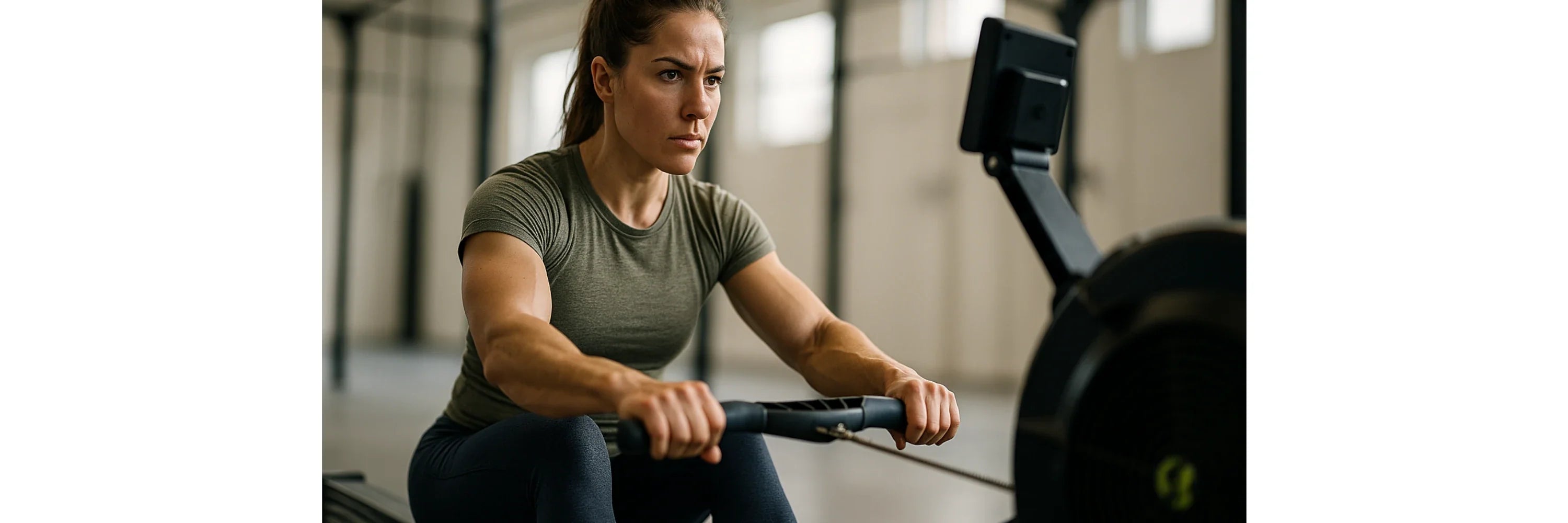
More power on the rower in your CrossFit workout
If you have been doing CrossFit for a while, you are surely very familiar with rowing on the Concept2 RowErg. This machine divides the athletic community: some could spend hours on it, while others only use it when it cannot be avoided. Basically, the rowing ergometer is an excellent piece of training equipment that engages the entire body and improves your endurance. However, when it comes to proper rowing technique, one often hears different opinions and arguments. Many claim that most of the power comes from the legs and that pushing off the footrests is the most important phase of the rowing stroke. But is that really true, or is there more to efficient rowing technique?
The correct rowing technique for CrossFit athletes
For CrossFit athletes, correct rowing technique is essential to avoid wasting energy and to get through a workout efficiently. The rowing stroke can be divided into four different phases.
Catch (Starting Position)
- Legs and hips: The knees are deeply bent, and the shins are approximately perpendicular to the floor. The hips are tilted forward.
- Upper body: Leaning slightly forward (about 11 o'clock), the back remains straight and stable.
- Arms: Fully extended and loose, hands gripping the handle in a relaxed manner.
This position optimally prepares the body for the drive phase, in which most of the energy is released.
Drive (Push Phase)
- Leg movement: Push powerfully with your legs to drive your body backward. The legs provide the initial propulsion. It is important here that the upper body remains slightly leaned forward until the legs are almost straight.
- Hip opening: As soon as the legs are nearly straight, open your hips and use that hip extension to pull your upper body back. This step is the most powerful part of the rowing stroke and provides the greatest propulsion.
- Arms: After the hips are opened, the arms pull the handle in a controlled movement toward the lower chest. The elbows move backward during this motion.
Finish (End Position)
- Legs: Fully extended, feet remain firmly in the straps.
- Upper body: Leaning slightly back (approximately at 1 o'clock), the back is stable and straight.
- Arms: The handle is close to the body, below the chest. The shoulders remain relaxed, and the elbows point backward.
This end position marks the end of the propulsion and the beginning of the recovery phase.
Recovery (Recovery Phase)
- Arms: First, the arms extend forward.
- Upper body: As soon as the arms are extended, the upper body leans slightly forward again (to about 11 o'clock).
- Legs: The knees bend to return to the starting position.
The recovery phase serves to prepare for the next stroke and to control body tension, ensuring a fluid, rhythmic movement.
Opening the hips: Why it is so important
The opening of the hips is a decisive factor in the rowing stroke. While many athletes focus on pushing with their legs, hip extension is the true key to efficiency. By powerfully opening the hips, the entire body is integrated into the rowing stroke, and energy transfer is optimized.
Maximum propulsion: Hip extension gives the upper body momentum and ensures a smooth transition to the arm movement.
Saving the legs: If the legs are used too heavily, it can lead to premature fatigue. Through hip opening, the load is better distributed, and the legs receive a brief recovery. Ever done box jumps after a rowing sprint?
Efficient power transfer: By opening the hips, the power of the entire body is optimally utilized, which is particularly advantageous in long workouts or intense intervals.
Tips for CrossFit athletes
Focus on power and control: Use your leg and hip power consciously and avoid jerky movements. Concentrate on distributing the power in a fluid transition from the catch to the finish.
Finding the right stroke rate: A stroke rate of about 25–30 strokes per minute is usually ideal in CrossFit. Frequencies that are too high lead to inefficient movements and increased fatigue.
Damper Setting: Many CrossFit athletes tend to set the damper to a high level to generate more resistance. However, a range of 4–6 is usually sufficient to achieve a good mix of strength and endurance. You can recognize the correct setting by the "frrrrrr" sound of the rapidly spinning fan.
Breathing technique: Breathing is important to supply the body with oxygen and keep going longer. Exhale during the drive phase and inhale during the recovery phase.
Regular technique training: As with any other CrossFit exercise, regular technique training is essential. Work on your movement pattern and ensure that every phase of the rowing stroke is executed cleanly and in a controlled manner.
A slightly different perspective on the rowing movement
This technique is used by James Hall. James Hall, the brother of Eddie Hall (known for his 500 kg deadlift record), holds the current world record for rowing on the Concept2 over 1000 meters in his age group. James's expertise goes beyond mere application of force. He relies on a thoughtful technique that makes every rowing stroke maximally efficient and explains that the greatest power in rowing is generated through the opening of the hips, not by simply pushing off with the legs. While the legs propel the body in the first phase of the rowing stroke, it is the hip extension that enables the decisive propulsion and the transition into the arm movement. This method not only ensures more efficiency but also a uniform and gentle distribution of the load on the body, which is particularly beneficial in long or intense WODs.
In the following YouTube video, James explains his rowing technique in detail starting at minute 10:20.
Conclusion
For CrossFit athletes, rowing on a rowing machine offers excellent training that improves strength, endurance, and technique. James Hall's approach shows that opening the hips during the rowing stroke has the greatest impact on efficiency and performance. By clearly focusing on this aspect, CrossFit athletes can not only improve their performance but also minimize fatigue.
Give this rowing technique a chance and try these tips in your training to get the most out of your rowing.



