
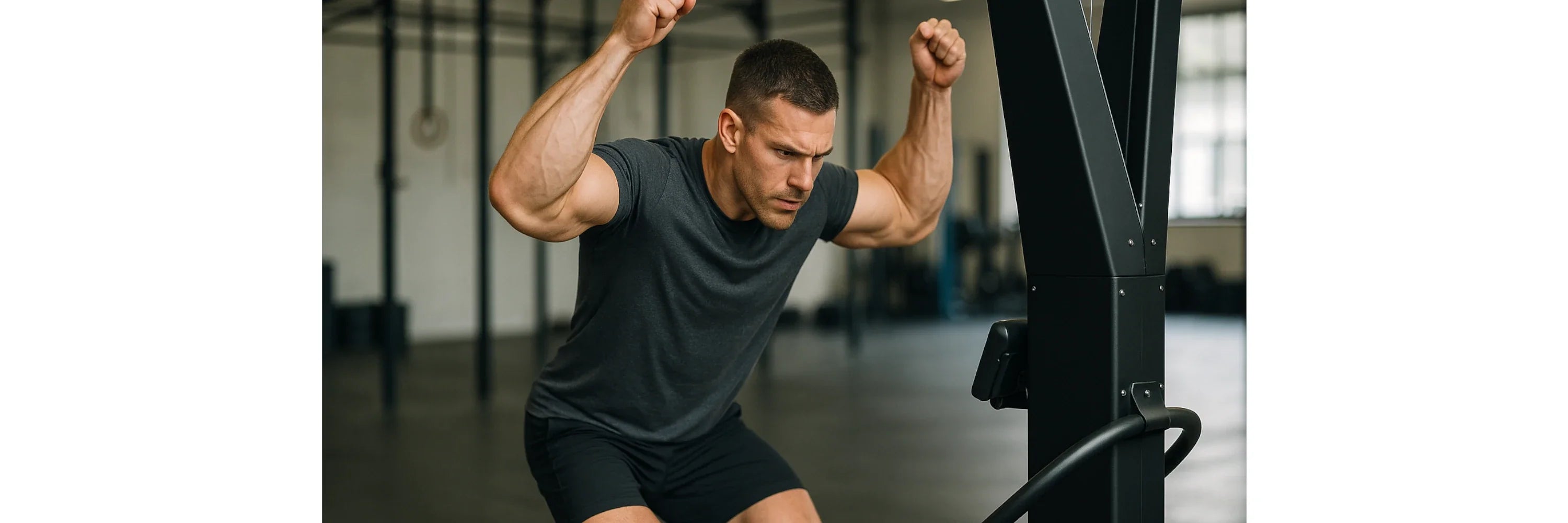
How to maximize your SkiErg performance in a CrossFit workout
Just like rowing on the Concept2 machine, the SkiErg is an integral part of CrossFit workouts. The SkiErg doesn't divide the training community as much as the rowing machine does, yet there are huge differences on the device. Some almost die the "SkiErg death," while others work their way through the required calories or distance seemingly effortlessly. But is the difference, as often claimed, down to limb proportions, body height, the color of one's training shoes, or is it actually the right technique?
The SkiErg is more than just a cardio machine
At first glance, the SkiErg might seem like a simple endurance machine, similar to a rowing ergometer. But anyone who takes a closer look at the movement quickly realizes: it is a full-body training tool that engages almost the entire body. The focus is on a dynamic, rhythmic movement of both arms, core, hips, and legs working together in a fluid sequence.
What makes the SkiErg special is its versatility: everything is possible, from targeted interval training to an endurance grind in a long MetCon. But one thing always remains the same: without the proper technique, the training quickly becomes inefficient, exhausting, and frustrating.
The most common mistakes that hold you back
Many athletes make fundamental mistakes on the SkiErg that significantly impair their efficiency and performance.
Starting from the top position: The pull should not start directly from the top end position, as this is often inefficient and hinders power transfer, especially from the latissimus.
Pulling only with the arms: Anyone treating the SkiErg like a cable pull machine in the gym is wasting massive potential. While the arms are involved, they should only act as support, as they are the weakest link in the chain.
Squatting too deep: A deep squat during the pull is a common mistake that reduces efficiency and strains the legs unnecessarily.
Hectic movements: A frantic style costs energy and causes you to burn out faster. Instead, work on a controlled, fluid sequence.
Wrong grip: A grip that is too tight leads to cramped forearms. Hold the handles loosely so that you can move them without requiring much force.
The right technique is a fluid movement
Good technique on the SkiErg is the foundation for success. It not only maximizes your efficiency but also protects you from unnecessary fatigue.
Starting position: Stable foundation
The starting position is crucial. Stand about shoulder-width apart and ensure that your weight is evenly distributed on both feet. Your knees are slightly bent, your back remains straight, and your shoulders are relaxed. The handles are roughly at forehead height. You need to be able to engage your latissimus cleanly.
The pulling motion: Efficiency through full-body engagement
The pull is the powerful part of the movement where you transfer energy to the handles.
- Initiate hip hinge: The movement starts from the hips. You lean forward slightly while your arms pull the handles toward the floor. This creates a fluid combination of pulling and using your body weight.
- Power from the core: Your abdominals and lower back stabilize the movement, while the arms act in a supporting role.
- End position: The handles should arrive at knee height without your torso dropping too low.
Imagine you are slamming a medicine ball into the ground with full force.
Return: Controlled and fluid
After the pull, it is important to return to the starting position without wasting energy.
- Hip extension: Stand up quickly and powerfully, bringing the handles back up in a controlled manner. Your movements should not be jerky.
- Breathing: Inhale deeply during the return and mentally prepare for the next powerful pull.
Avoid completely losing body tension during the return. While you want to relax during this part of the movement, you do not want to lose unnecessary time before you can start the next pull.
In the following YouTube video, James Hall explains the secret behind the technique he used to set the 1000m and 2000m world records on the SkiErg.
The hip movement is the heart of your efficiency
The hips are the center of your body and play a key role on the SkiErg. They are the connection between the upper and lower body and enable the transfer of power from the legs and core to the handles.
How the hip movement works:
- Hinge for power: When pulling, you hinge your hips slightly, bringing your torso forward. This movement activates the posterior chain (glutes, hamstrings, back) and provides a powerful base.
- Extend for control: During the return, you extend the hips again, bringing yourself into a stable starting position.
Many athletes make the mistake of working too much with their arms or squatting too deeply. This is not only inefficient but also causes the large muscle groups to go unused. The hips, on the other hand, are a powerhouse. Use them correctly and you will become faster, stronger, and more resilient.
Tips for increasing your performance in workouts
CrossFitters are often faced with the challenge of integrating the SkiErg into workouts with high intensity and varied requirements.
Technique before intensity: Especially in stressful workouts with time pressure, it is easy to fall into bad habits. Resolve to keep your technique clean, even under strain. This is not only more efficient but also prevents you from burning out prematurely.
Distribute load intelligently: Avoid overloading your arms and shoulders, especially if exercises like pull-ups or thrusters follow the SkiErg. Rely instead on the power of your hips and core.
Set resistance optimally: The SkiErg damper can be seen like a gear shifter. A setting that is too high often leads to inefficient technique; one that is too low makes it difficult to generate power. Experiment with different settings to find the balance that suits you best.
Pace management: For long workouts, it pays to maintain a consistent speed. Do not start too fast; instead, find a rhythm that you can sustain. It does you no good if you need a break after the SkiErg before you can move on to the next movement.
Conclusion
The Concept2 SkiErg is a demanding but incredibly rewarding piece of training equipment. With the right technique, a clear focus on hip movement, and the avoidance of common mistakes, you can not only make faster progress but also enjoy training more. For CrossFitters, it is an indispensable tool for improving strength and endurance—if you know how to use it correctly.
Invest time in your technique, work on your efficiency, and let the versatility of the SkiErg inspire you.



