
Learning the Overhead Squat: Technique, Muscles, and Mobility
The overhead squat is called "Überkopfkniebeuge" in German. Quite clunky and not very sexy. That’s why we’ll stick with "overhead squat." It’s not called the "king of squats" for nothing. The barbell loaded with weight plates isn't resting on your neck as usual, but held overhead in a snatch grip. And all of this while performing deep squats. Execution isn't exactly easy, especially as the weight on the barbell increases. Anyone who wants to nail a snatch has to master the overhead squat—and anyone who has mastered the deep squat under load has already checked off 80% of the snatch receiving position.
In a nutshell
Snatch grip overhead, deep squat — the king of squats.
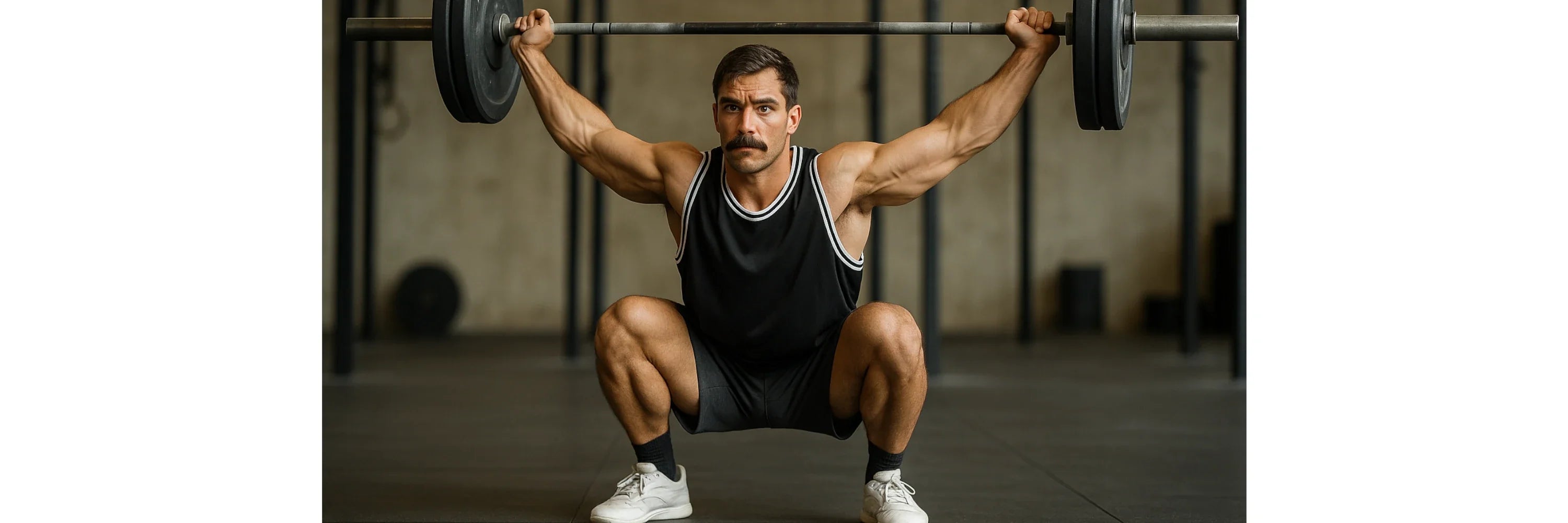
- What it is: Overhead squat. You hold the barbell with a snatch grip, arms fully extended overhead, and squat down deep — the barbell must remain over your midfoot at all times.
- What it trains: Legs, glutes, entire core, shoulders, and rotator cuff — plus the rare combination of shoulder, hip, and ankle mobility.
- How to start as a beginner: First mobility (shoulders, thoracic spine, ankles), then a PVC pipe or empty barbell, then weight. Those who take shortcuts here will develop poor posture.
Let's get started.
What is the overhead squat?
The overhead squat is a variation of the classic squat. The difference: You hold the barbell with a wide snatch grip above your head while squatting down. The barbell must always remain over your center of gravity, which requires tremendous core tension, shoulder stability, and mobility.
How to perform it correctly
Stance and grip:
- Place your feet shoulder-width apart with your toes slightly pointed out, just like in a classic squat
- Hold the barbell overhead in a snatch grip
Overhead position:
- Arms are fully extended, elbows pointing slightly outward
- Barbell over the midfoot, shoulder blades actively pulled upward
Downward movement:
- Knees and hips bend at the same time
- Back remains upright and core is engaged
- Keep the weight stable over your head
Squat position:
- As deep as possible, ideally until hamstrings touch calves
- Knees are in line with toes and actively pushed outward
- Ensure elbows remain fully extended
Rising:
- Push upward from the bottom with tension
- The barbell remains steady and stable overhead
Overhead squat muscles: Which muscle groups are trained?
The overhead squat is a true full-body exercise and places significant stress on the following muscle groups.
- Legs and glutes: Quadriceps, gluteus, hamstrings
- Core: Abdominals, spinal erectors, obliques
- Shoulders and upper back: Deltoids, trapezius, rotator cuff
- Stabilizers: Deep muscles for balance control
What the exercise does for weightlifting and CrossFit
Weightlifting:
- Essential component of the snatch and gets you used to heavier weights
- Improves balance, flexibility, and body control
- Strengthens confidence under the bar and creates certainty that you can stand up with heavy weights
CrossFit:
- Trains strength, mobility, stability, and technique in one exercise
- Transfers positively to many other movements like thrusters, snatches, and jerks
What are typical problems for beginners?
The overhead squat is often a real challenge for beginners, and not necessarily because of the weight. One of the most common hurdles is limited mobility, especially in the shoulders and ankles. The overhead squat requires you to keep your arms extended overhead while squatting down deep. This is a position many can barely reach without targeted training. Another typical problem is a lack of core stability. If the abdominal and back muscles do not maintain sufficient tension, the upper body tips forward, which makes the whole movement unstable and increases the risk of poor posture. Knee position is also often a problem: many beginners subconsciously let their knees collapse inward during the descent, which can strain the joints over time. Finally, beginners often lack the body awareness for the correct overhead position.
How to learn the overhead squat as a beginner
Anyone starting with the overhead squat should focus primarily on technique, mobility, and stability, not on weight. Because only when the foundation is solid can a clean and long-term safe movement develop. The path there starts with targeted preparation. First, it is worth working on flexibility. Many problems with the overhead squat arise because the shoulders, thoracic spine, or ankles do not have enough freedom of movement. To improve shoulder mobility, exercises with a resistance band, where the arms are pulled overhead or opened to the sides, are helpful. Hyperextending the thoracic spine over a foam roller also improves upper body posture. Additionally, deep squats with a counterweight in front of the chest are a proven way to improve hip and ankle mobility and develop a feel for the deep position. Once mobility is in a good range, the goal is to learn the movement pattern, initially without any additional weight. A PVC pipe or broomstick can be a great help for practicing the correct arm position, grip width, and movement. An empty barbell is also perfectly suitable for this, as it is difficult to get a feel for the position with a PVC pipe or broomstick. As mentioned above, stability in the shoulder girdle and core is a prerequisite for the overhead squat. This ensures that the upper body remains upright and the barbell does not wobble. When technique and basic stability are correct, the load can be gradually increased.
Tips for clean overhead squats
- Start with light weight and perfect your technique
- Find your optimal grip and try different grip widths
- Use weightlifting shoes if necessary
- Train mobility regularly – shoulders, hips, ankles
- Use mirrors or video recordings to check posture and technique
- Film your sets from the side, not from the front — you can only see leaning forward and hip creases in profile
Conclusion
The overhead squat is one of the most technically demanding variations of the squat. It forces you to harmonize strength, flexibility, stability, and coordination. Mastering this movement not only improves your squat performance but also your posture, core stability, and movement quality in general. In CrossFit, it is an important building block for many complex workouts; in weightlifting, it is the basis for a solid snatch. But even outside of these disciplines, the overhead squat ensures more body control, injury prevention, and athletic performance. Anyone who takes the time to improve their mobility, build technique cleanly, and practice consistently will become stronger, more stable, and more confident in all movements in the long run.



