
How to train your grip strength effectively
Whether you're lifting heavy in the gym, doing pull-ups, or lugging heavy shopping bags home in your daily life, your grip strength plays a vital role. It helps determine how long you can hold a load, how securely you control a weight, and whether you can maintain proper technique. People often only realize how important grip strength is when it becomes the weakest link in the chain. Your forearms burn, your hands slowly open on their own, and this happens even though the rest of your body could actually keep going. Yet, strong grip strength is not just a marginal detail; it is a genuine performance factor. In strength sports and functional training, it can make the difference regarding repetitions, technique, and safety. But it is also indispensable in everyday life—for example, when carrying heavy objects, opening a stubborn jar, or performing manual labor. But what exactly constitutes good grip strength? Why is it so important for many athletes, and how can you improve it in a targeted way?
In a nutshell
For those who want to get smarter fast—here are the essentials.
- Grip strength is an indicator of health and longevity.
- A 90-second dead hang puts you in the above-average category for grip strength.
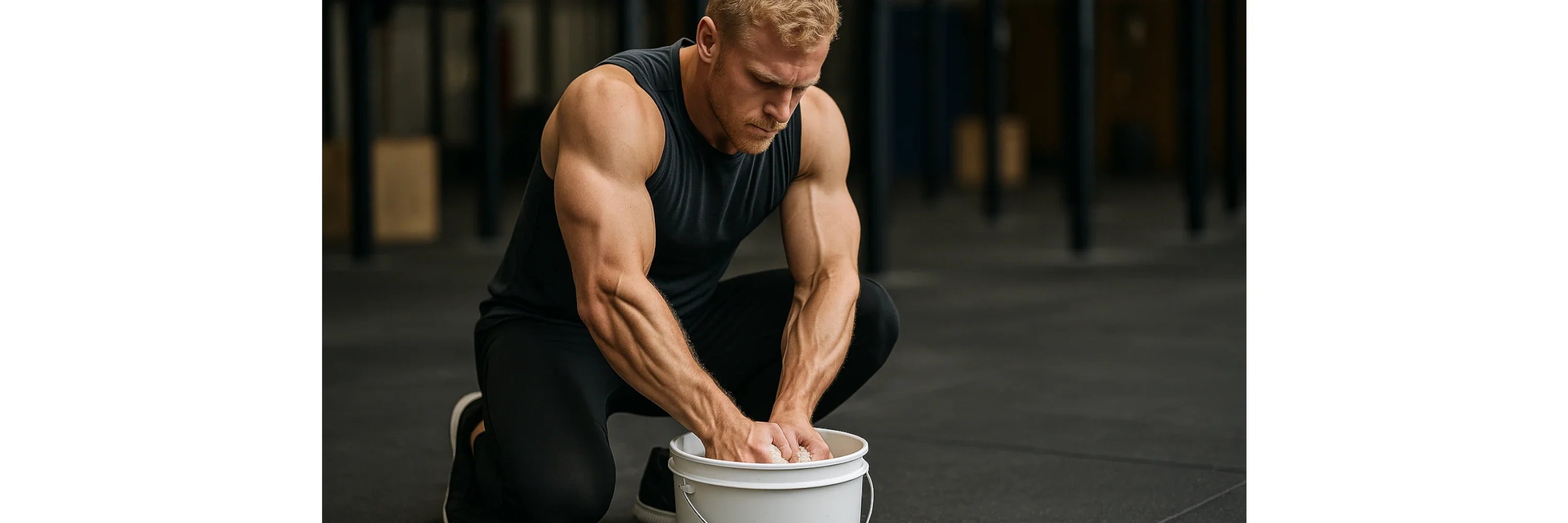
- Kneading dry rice in a bucket improves your grip strength.
Let's get started
What is grip strength?
Grip strength describes the ability of your hands, fingers, and forearms to exert force—in other words, to grip, hold, or pull something. There are different types of grip strength:
- Crush grip: The strength used to squeeze, e.g., when shaking hands or using a hand gripper.
- Pinch grip: Strength between the thumb and fingers, e.g., when holding weight plates.
- Support grip: Strength to hold onto something for a longer period, e.g., during a farmer's carry or a hang.
- Wrist strength: Wrist stability, e.g., during snatches or cleans in weightlifting.
Why is grip strength important?
Grip strength is a true performance booster that plays a key role in many areas—often without you consciously realizing it. Anyone who regularly engages in strength sports, CrossFit, or functional training knows the problem: you could actually manage a few more repetitions, but your hands give out first. Especially in exercises like deadlifts, pull-ups, muscle-ups, or rope climbs, grip is often the limiting factor. But grip strength is also of enormous importance outside of training. It protects against overload in the wrists, elbows, and shoulders because it stabilizes the surrounding joints. In everyday life, it helps you carry heavy items or do manual tasks. And it is even relevant from a medical perspective: studies show that good grip strength is associated with a higher life expectancy and a lower susceptibility to disease—it is, therefore, a true indicator of health.
Performance in training: You cannot pull heavy deadlifts or cleans if you cannot hold the barbell. Grip is also often the limiting factor for toes-to-bar, rope climbs, or muscle-ups.
Injury prevention: Strong hands and forearms stabilize the wrist, the elbow, and indirectly even the shoulder—this reduces your risk of injury.
Everyday utility: Carrying heavy bags, moving furniture, or carrying a child—here, too, your grip often decides how long you can last.
Health indicator: Did you know that studies show that good grip strength is linked to a longer life expectancy and lower susceptibility to disease?
How can you measure your grip strength?
There are several ways to measure your grip strength—some of which you can easily perform at home. One of the simplest methods is the dead hang test. You hang from a pull-up bar and hold on for as long as possible. The rule of thumb: anything under 30 seconds shows room for improvement, 30 to 60 seconds is average, and anyone who can manage longer than 90 seconds has above-average grip strength. A bit more demanding is the farmer's carry max test. Here, you walk a defined distance—for example, 20 meters—with two heavy dumbbells or kettlebells and see how much weight you can carry stably. More professional, but less practical for everyday use, is a hand dynamometer. This device measures how many kilograms of force you exert when squeezing. It is often used in medicine and sports science.
How can you train your grip strength?
There are many effective exercises you can use to work on your grip strength in a targeted way.
Training with equipment
Dead hangs: You hang from a pull-up bar and try to hold on for as long as possible. A simple but very effective exercise for improving holding strength. For more intensity, you can use additional weight.
Farmer's carry: You take two heavy dumbbells or kettlebells in your hands and walk a certain distance. This exercise strengthens not only the grip but also the core and posture.
Gripper training: With special hand trainers, such as Captains of Crush, you specifically train the squeezing strength of the hand.
Plate pinches: You take two weight plates and press them together by the smooth sides using only your fingers. Hold them as long as possible. This specifically trains your pinch-grip ability.
Towel pull-ups / hangs: You throw a towel over a pull-up bar and grip the ends. You either hang from them or perform pull-ups. This significantly increases the demands on your grip.
Kettlebell bottom-up press: You hold a kettlebell with the handle at the bottom and press it overhead. The unstable position challenges both your grip strength and your coordination.
Forearm curls: Grip a dumbbell or barbell with an underhand grip and move the weight up and down using your wrist to specifically strengthen the forearm flexors.
Wrist roller: An exercise where you roll a weight up and down on a cord attached to a bar or handle.
Without equipment
Isometric gripping: Make a fist and squeeze as hard as possible for about 30 seconds. Three sets per hand. Ideal for anywhere and at any time.
Rice or sandbag training: Put your hand into a bucket of dry rice or sand and repeatedly make fist movements. This trains many small hand and finger muscles.
Finger push-ups: Perform push-ups on your fingertips instead of your palms. Demanding, but excellent for finger and wrist strength.
Dead hang on a door frame: Hang from a sturdy door edge or door frame and hold the position for as long as possible. Good training for finger strength and holding capacity.
Conclusion
Strong grip strength is far more than just a nice side effect. It is a central component of your overall performance in training and daily life. Whether you are lifting heavy weights, doing pull-ups, or simply carrying shopping bags: your grip often determines how long you can last, how cleanly you move, and how well you stay injury-free. Grip strength can be trained in a targeted and effective way. Those who regularly integrate exercises like dead hangs, farmer's carries, or plate pinches into their training not only lay the foundation for more strength and control but also for long-term health and everyday functionality.



