
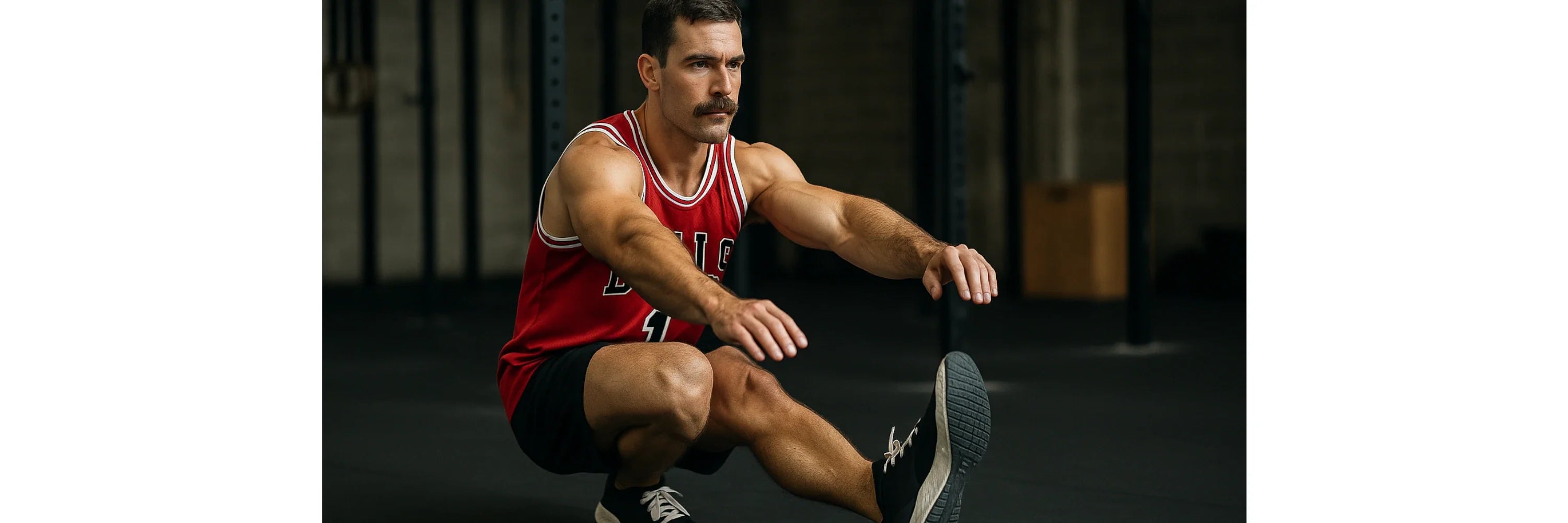
How are pistol squats performed correctly and how can you learn them?
Strong, controlled, and elegant, pistol squats are among the most demanding bodyweight exercises for the legs. Performing them with good form combines leg strength, core tension, balance, and flexibility into a single fluid movement. It is no wonder, then, that they are considered a true benchmark in CrossFit boxes, calisthenics parks, and functional gyms. However, the single-leg squat is not just for show or advanced athletes. It is also an extremely effective tool for building muscle, stabilizing joints, and training the legs without any equipment at all.
In a nutshell
For those short on time and full of curiosity—here is the summary.
- No, pistol squats are not bad for your knees.
- Yes, you can build muscle with this exercise.
- The progression from pistol squats is dragon squats.
And off we go
How to perform pistol squats correctly
A pistol squat is a single-leg squat where you lower yourself into a crouch slowly and with control until your glutes almost touch the floor. You extend the other leg forward without the foot touching the ground during the entire movement. Your upper body leans slightly forward to maintain balance. A clean repetition ends back in the upright, single-leg standing position. Pistol squats are not just a strength exercise; they also require a good dose of balance, core tension, and flexibility. Anyone who masters them demonstrates not only strong legs but also control over their entire body.
Which muscles are trained by pistol squats
In pistol squats, the focus of the exercise is on the legs.
- Quadriceps: Responsible for knee extension—the main player.
- Gluteus maximus: Assists with hip extension and stabilization.
- Hamstrings: Act as supporting muscles.
- Calf muscles: Stabilize the ankle joint, especially during the upward movement.
- Core muscles: Necessary to maintain balance and keep the torso stable.
What are the benefits of pistol squats
Building muscle with your own body weight: Due to the single-leg execution, the entire body weight puts load on just one leg. This makes the exercise significantly more intense than regular air squats. Ideal for building strength and muscle mass, even without equipment.
Improving balance and core tension: Pistol squats require a great deal of stability, especially in the trunk. This also trains the often-neglected deep muscles.
Increasing flexibility: A clean pistol squat requires good flexibility in the ankle and hip. Through regular practice, your mobility improves automatically, which in turn has a positive effect on all other movements.
Joint stability and injury prevention: When you work with controlled technique, you strengthen the muscles and tendons around the knee. This can help prevent injuries—especially in sports or everyday life.
No equipment needed: You do not need any extra material—you can practice pistol squats anywhere.
Are pistol squats bad for the knees
This question is heard again and again and is certainly justified at first glance. After all, the movement looks very unusual. The knee goes far over the toes, the angle is extreme, and the leg is under full load. For healthy people and when performed correctly, pistol squats are not harmful. They can even have a positive effect on knee health if you approach them correctly.
- Clean technique: The knee should remain stable and not buckle inward.
- Good preparation: Anyone who tries to perform the exercise immediately without mobility or strength often overloads their knee joint.
- Use progressions: Start with easier preparatory exercises and increase intensity step by step.
How best to learn pistol squats
Without any prior knowledge, you shouldn't just jump into pistol squats; instead, approach them gradually.
Level 1: Building the foundations
- Deep air squats (with full hip and knee flexion)
- Split squats or Bulgarian split squats for single-leg strength
- Single-leg stance + wall sit to train balance and tension
Level 2: Controlling partial movements
- Box pistol squats: Sit down on one leg onto a box or bench
- TRX or railing-assisted pistols: Hold on for balance
- Negative pistols: Slowly go down on one leg, come up with both legs
Level 3: Full repetitions
- Start with 2–3 clean repetitions per leg
- Pay attention to stable knee alignment, core tension, and flexibility
- Increase intensity by pausing at the bottom or adding weight
What are dragon pistol squats
The dragon pistol squat is a particularly demanding variation of the classic pistol squat and combines a single-leg squat with a dynamic cross-over movement. While you lower yourself in a controlled manner on one leg, you guide the free leg behind the standing leg diagonally to the side—like a sweeping dragon's tail, hence the name. This movement requires not only strong leg muscles but also exceptional hip mobility, core stability, and body control. The rotation of the non-working leg makes the exercise a real challenge. At the same time, you train balance and coordination on a completely new level. Dragon pistol squats are ideal for advanced athletes who are already secure in the normal pistol squat and want to further improve their movement quality.
Conclusion
The pistol squat is far more than just an impressive single-leg squat. It is a true all-in-one tool for functional strength, stable joints, better flexibility, and a refined sense of body awareness. Performed correctly, it makes you not only stronger but also more controlled, flexible, and resilient—all without any additional equipment. But it is also a challenge. The road to a clean pistol squat takes time, patience, and a good amount of ambition. It is not about mastering them perfectly immediately, but about getting better continuously. Every step, every repetition brings you closer to your goal.



