
How to perform the Jefferson Curl correctly — technique, muscles, risks
Jefferson curls are among the less commonly seen but extremely effective exercises in strength and mobility training. Unlike most classic strength exercises, the spine is deliberately rounded vertebra by vertebra in a slow and controlled manner. This targeted movement allows for simultaneous improvement of strength and flexibility, while training the posterior chain—the hamstrings, glutes, and spinal erectors—through an exceptionally large range of motion. The purpose of this exercise is the hamstring stretch, leading to greater flexibility in the backs of the thighs, better control over each individual spinal movement, and strength development even in positions often neglected in standard training. When performed correctly, Jefferson curls are not only an excellent exercise for performance enhancement but also a sensible measure for injury prevention. But how exactly does the Jefferson curl work? What are the benefits, and what are the most common mistakes?
In a nutshell
Straight to the point – understandable and time-saving.
- The Jefferson curl improves the hamstring stretch.
- The added weight allows for a deeper stretch.
- It improves body awareness and motor control.
Let’s get started
What is the Jefferson curl
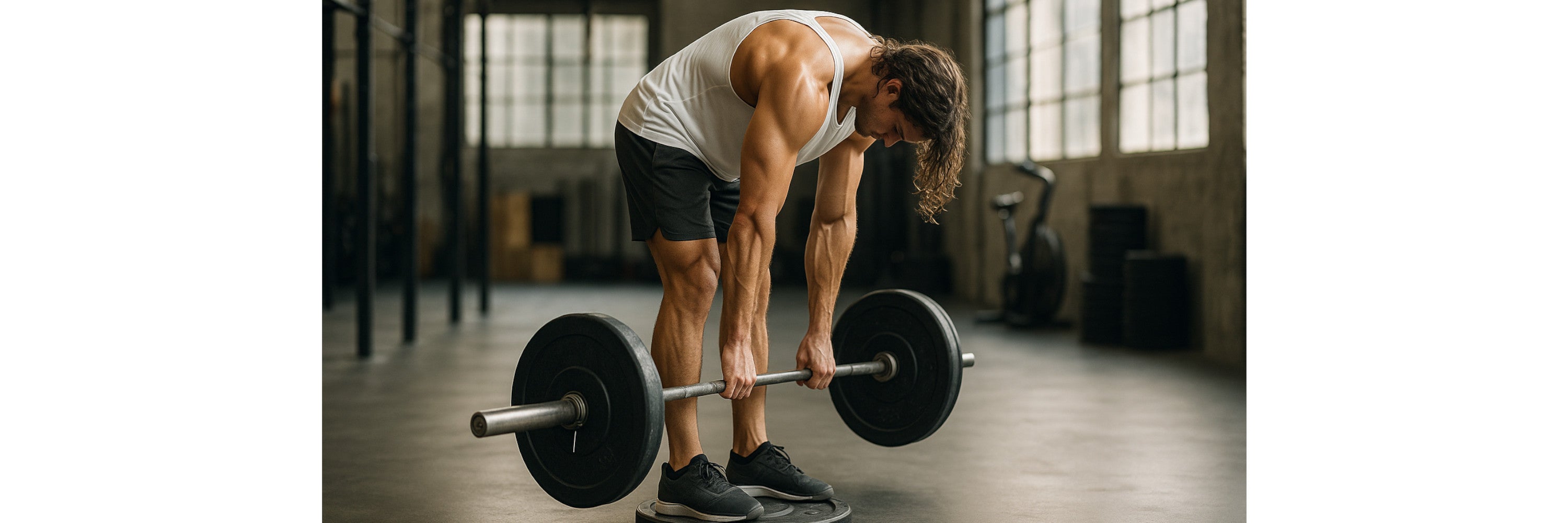
Unlike classic exercises such as deadlifts or good mornings, the spine is consciously rounded during Jefferson curls. The goal is not to maintain a neutral posture, but to slowly bring the spine into flexion vertebra by vertebra. Usually, you stand on an elevated surface and hold a weight in front of your body while rolling downward in a controlled manner. At the lowest point, the weight should ideally hang below your feet before you slowly straighten back up.
Why you should incorporate the J-curl into your training program
- Improve flexibility in the posterior chain: Hamstrings, glutes, and the lower back are loaded in a deep stretch, which enables more flexibility than static stretching alone.
- Build strength in end positions: Athletes often lack strength and control at the extreme end of their range of motion (e.g., during deep forward bends or the catch position in weightlifting). Jefferson curls train exactly this point.
- Train spinal control: Instead of keeping the spine stiff, you learn to consciously roll it in vertebra by vertebra. This improves segmental mobility and muscular control.
- Injury prophylaxis: A strong, mobile spine reacts better to unforeseen stresses. This is important for sports like CrossFit or weightlifting.
- Mental control and technique training: The extremely slow tempo trains focus, body awareness, and technique—which carries over to other lifts.
Step-by-step instructions
Starting position: Stand barefoot or in flat shoes on a weight plate or plyo box. Hold a light barbell, kettlebell, or dumbbell in front of your body.
Execution: Take a deep breath. Move your chin toward your chest and roll down vertebra by vertebra. Let the weight hang down in a controlled manner as you continue to roll in. Hold briefly at the lowest point. Roll back up just as slowly, starting from the lower back.
Breathing: Breathe calmly and in a controlled manner; do not strain or hold your breath.
What are the benefits of Jefferson curls
- More flexibility in the hamstrings: The added weight allows for a deeper stretch of the posterior thigh muscles—often deeper than classic static stretching.
- Better control over the spine: By consciously controlling every vertebral movement, you improve your body awareness and motor control.
- Strengthening the spinal erectors at the end range: You train your strength at the extreme range of motion, where many athletes are not as strong.
- Useful carry-over effects: The gained mobility and strength are particularly valuable for deep squats, the snatch or clean in weightlifting, and gymnastic elements.
What are common mistakes in Jefferson curls
- Too much weight: This increases the risk of injury and reduces the quality of movement.
- Lack of control: Simply dropping downward does not train the desired vertebral mobility.
- Execution too fast: If the movement is too fast, it is difficult to perform it correctly and concentrate on the body.
- Using momentum: Makes the exercise less effective and can overload the back.
Is the Jefferson curl dangerous?
No, the Jefferson curl is not inherently dangerous—if you adhere to three things: a light starting weight, a controlled tempo, and an honest assessment of your daily physical state. The exercise has a reputation for being risky because it violates a rule considered sacred in any strength training: bending the spine under load. That is exactly what you are doing here—consciously, slowly, with minimal load. This sounds like a beginner's mistake, but it is a controlled mobility exercise.
The perception that the "Jefferson curl is dangerous" stems from traditional lifting: in a deadlift or squat, a rounded back under heavy load is an injury risk. Here, the load is intentionally small—you start with an empty bar, a light kettlebell, or 5 to 10 kg. The load per vertebra remains low, and the range of motion is built up slowly. Studies on spinal load tolerance show that controlled flexion with an adapted load is well-tolerated when the tissue is gradually accustomed to it.
Nevertheless, the exercise is not suitable for everyone. You should avoid it or consult your doctor or physical therapist first in the following cases:
- Herniated disc or acute back pain: Flexion under load exacerbates symptoms.
- History of spinal surgery: Clarify individual load limits.
- Osteoporosis: Increased risk of vertebral fractures during flexion under load.
- Acute hamstring injuries: Maximum stretching can disrupt the healing process.
- Pregnancy: Relative contraindication—in case of doubt, consult your midwife or doctor.
If you are healthy and build up the exercise properly, the rule is: light weight, roll in and out controlled vertebra by vertebra, two to three seconds per phase, and do not push into the end range of mobility if it pinches. Those with pre-existing conditions or doing the exercise for the first time are well-advised to have brief guidance from a trainer or physical therapist.
Who are Jefferson curls suitable for?
Suitable for:
- Athletes in CrossFit and weightlifting
- Individuals who want to actively improve their mobility
Not suitable for:
- Acute back injuries
- Disc problems
- Severe pain during movement execution
Conclusion
Jefferson curls are an extraordinary exercise that specifically combines strength and mobility in the posterior chain. By consciously and slowly flexing the spine, not only is the hamstring stretch improved, but control and strength are also built in ranges of motion that are often neglected. When performed correctly, they are a valuable exercise for performance enhancement and injury prevention—especially for athletes in CrossFit and weightlifting. Success depends on a controlled tempo, a light starting weight, and clean execution. This turns an unassuming exercise into an effective building block for long-term strong and mobile structures.



