
Front Squat vs. Back Squat: What is the difference?
Squats are arguably the king of all strength training exercises. Hardly any other movement engages so many muscles simultaneously or has such a great carryover to everyday life, sports, and performance. While the back squat with a barbell on the shoulders is well-known to many, the front squat is often underestimated. Yet, it offers distinct advantages, especially in CrossFit and weightlifting training. But how are front squats performed correctly? Which muscle groups are targeted, and what are the differences compared to back squats?
In a nutshell
The quick snack of knowledge.
- One of the most common mistakes during front squats is the knees collapsing inward during the upward movement.
- The focus of the load in a front squat is on the quadriceps.
- Can be performed with a barbell, a safety bar, kettlebells, or dumbbells.
Let’s get started
What are front squats?
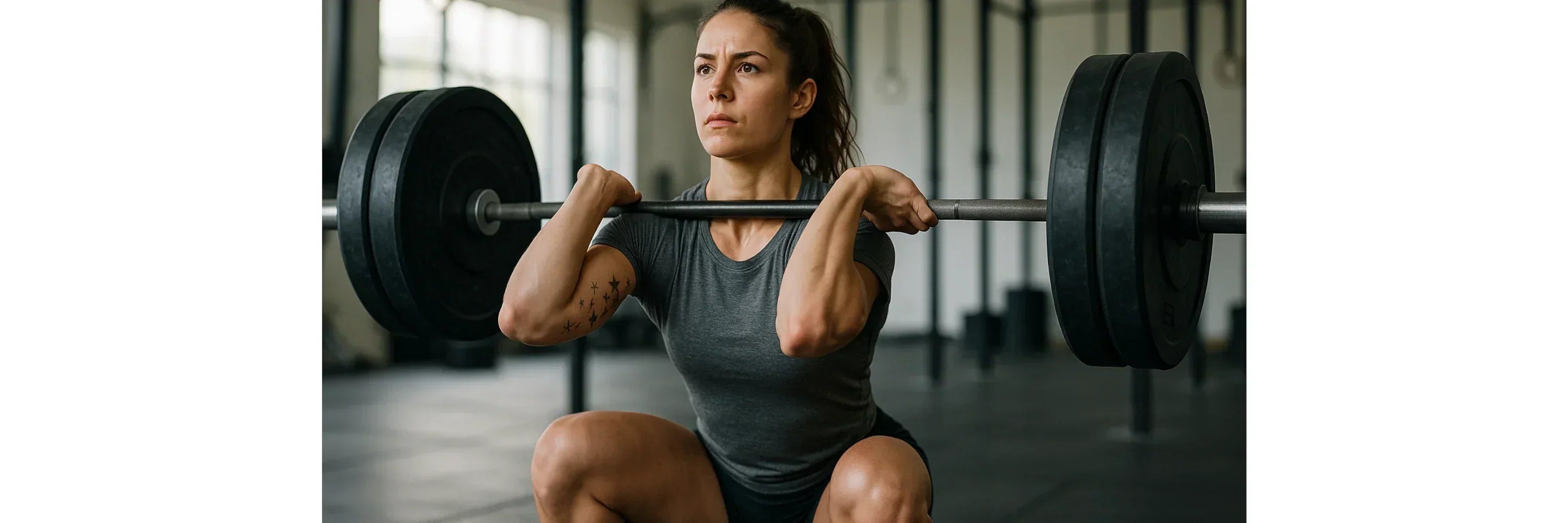
In a front squat, the barbell rests not on the upper back, but on the front of the shoulders. The elbows point forward, and the torso remains significantly more upright than in a back squat. This changes the load: the quadriceps work harder, while the lower back is under less stress. Front squats are a standard exercise in Olympic weightlifting because they directly prepare you for the clean & jerk, and they are also an indispensable component of many CrossFit workouts.
How to perform front squats correctly
At first glance, the front squat looks simple: place the barbell on your shoulders and squat. In practice, however, there is a lot of technique involved because posture and balance play a major role.
Preparation: Set the rack so that the height of the barbell is roughly at chest level. This allows you to lift it out easily without having to stand too high on your tiptoes or squat deep underneath it. Position your feet about hip- to shoulder-width apart, with your toes turned slightly outward.
Grip: There are two common types of grips: the clean grip and the cross grip. With the clean grip, the barbell rests on the front of your shoulders, your fingertips touch the bar, and your wrists are heavily bent. Important: keep your elbows high, almost parallel to the floor. With the cross grip, the arms are crossed over. Your hands secure the bar on your shoulders. This variation is easier for beginners as it requires less wrist mobility, but it is less stable.
Starting position: Lift the barbell straight up out of the rack. Take two small steps back to create space. Stand stably with your feet firmly planted on the ground. Engage your core: your abdominal and lower back muscles work simultaneously to maintain a neutral spine. This is also known as the Valsalva maneuver.
The downward movement: Bend your knees and hips at the same time, keeping your torso as upright as possible. Actively push your knees outward so they stay in line with your feet. Your weight remains evenly distributed over the entire foot, with your heels remaining on the floor at all times. Lower yourself in a controlled manner until your hips are lower than your knees.
The upward movement: Keep your core tight, elbows high, and chest open. Push yourself powerfully upward through your heels. Imagine pushing the floor away from you. Extend your hip and knee joints simultaneously, avoiding pushing your hips forward. Keep pushing your knees outward throughout the entire movement.
Technical details: A decisive point in the front squat is the posture throughout the movement. The elbows are particularly important: they must always be held high, as this is the only way the barbell remains stable on the shoulders and does not roll forward. Your gaze also plays a major role—direct it straight ahead or slightly upward to keep the torso upright and stable. Regarding tempo, the basic rule is: go down slowly and in a controlled manner to maintain tension, then push up explosively. Speed is secondary; clean technique always takes priority. Depth is also crucial—go as low as your mobility allows without rounding your back. If you encounter limitations, targeted mobility training for your hips and ankles will help improve your execution piece by piece.
Which muscles are trained?
Quadriceps: The primary focus, worked more intensely than in back squats.
Glutes: Provide support during the upward push.
Adductors: Help with stabilization and depth.
Core: Ensures stability and an upright posture.
Upper back: Stabilizes the barbell on the shoulders.
Common execution mistakes
Elbows dropping: The barbell rolls forward.
Rounded back: Overloading the spine.
Knees collapsing inward: The load is distributed unevenly, putting more stress on the knee joint. Additionally, tension in the glutes and thigh muscles is lost, making the movement inefficient and costing performance.
Heels lifting off: Insufficient ankle mobility.
Insufficient core tension: Unstable posture and loss of energy.
Front squats vs. back squats
Front squats and back squats differ primarily in their focus of load and technique. While the front squat stresses the quadriceps more, requires an upright posture, and thus puts less pressure on the lumbar spine, it is technically more demanding and requires good mobility in the shoulders, wrists, and ankles. Back squats, on the other hand, usually allow for heavier training weights because the barbell lies more stably on the back, and they shift the load more toward the glutes and hamstrings, with lower upper-body mobility requirements. Both variations have their place: if you primarily want to build raw strength and mass, back squats are a great choice, whereas front squats are indispensable for CrossFitters and weightlifters because they challenge the core and provide direct carryover to Olympic lifts.
Different variations of front squats
Barbell front squat: Standard execution as in weightlifting; the bar rests on the front of the shoulders.
Zombie squat: The barbell rests only on the shoulders, and the arms are extended forward. This forces the core to work extremely hard to remain stable—an exercise with a heavy focus on core strength.
Safety-bar front squat: Performed with a special safety bar. Simplifies the grip position and is easier on the wrists and shoulders, making it well-suited for athletes with mobility issues.
Dumbbell front squat: Performed with two dumbbells in front of the shoulders, usually resting slightly on the shoulders. This variation is very close to the classic front squat but requires more stabilization work because the weights must be controlled independently.
Kettlebell front squat: Can be performed with either one or two kettlebells. With one kettlebell in the goblet position, it is essentially a goblet squat—perfect for learning correct squat technique and an upright posture. With two kettlebells in the front rack position, the exercise becomes more demanding as grip strength and core stability are also heavily challenged.
Benefits of front squats for CrossFit
Front squats have a special status in CrossFit because they train several important skills simultaneously. For one, they are the direct foundation for exercises like cleans and thrusters. If you want to develop clean technique here, you cannot avoid the front squat. After all, the position in which the barbell is caught during a clean is essentially nothing more than a front squat with additional momentum. Therefore, improving your front squats will automatically make you more secure and stable when lifting heavy weights. The same applies to thrusters, which combine a front squat with a subsequent overhead press. Furthermore, the front squat strengthens the core tremendously. The upright torso forces you to keep your abdominal and back muscles under constant tension. This pays off in many other CrossFit movements, such as overhead squats or snatches, where a solid core determines success or failure. The more stable your core is, the easier it is to control and cleanly move heavy loads overhead. Another advantage of the front squat in CrossFit is that it helps you develop a clean and deep squat position. Many athletes initially have trouble reaching the proper depth without lifting their heels or rounding their backs. The front squat encourages exactly this technique because it forces you to remain upright and guide your hips cleanly downward. If you make progress here, you will benefit not only in squats but in all movements that require good mobility and a stable lower-body position.
Conclusion
The front squat is far more than just an alternative squat variation—it is a key exercise for strength, stability, and technique. Due to the upright posture, the quadriceps are emphasized more strongly, while the core must work intensely to stabilize the barbell securely. This makes it not only an excellent exercise for muscle building but also an important building block for CrossFitters and weightlifters, as it carries over directly to movements like the clean & jerk or the thruster. Even if the front squat requires more technique, mobility, and body awareness at the beginning, the investment is worth it: those who train it regularly not only improve their strength performance but also their mobility, posture, and injury resistance—thereby laying a stable foundation for almost any athletic discipline.



