
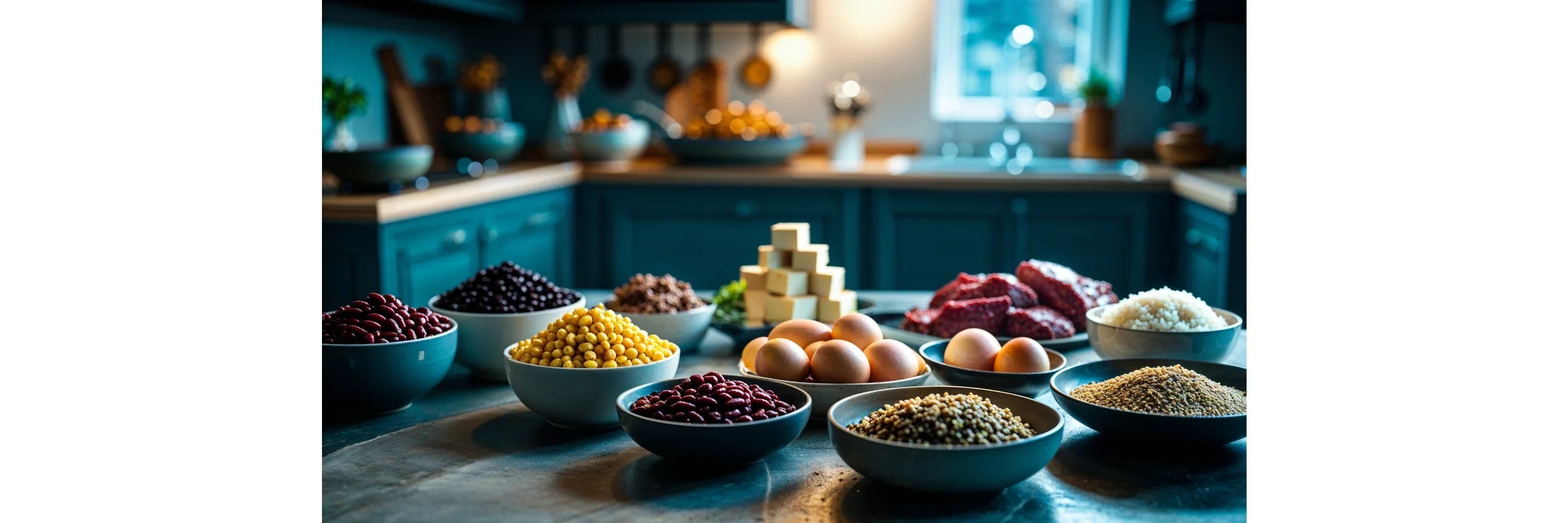
What is the biological value of proteins?
Proteins are the essential building blocks of life. Our body uses them to build muscles, organs, enzymes, and hormones. However, not all proteins are created equal. The biological value of a food indicates how efficiently the body can convert the contained protein into its own body protein and how complete the amino acid profile is. This value is an important indicator of the quality of a protein source and plays a major role in nutritional science, sports nutrition, and certain dietary patterns.
What is biological value
The biological value (BV) of a food is a measure of how well the protein from food can be converted by the body into its own body protein. It depends primarily on the composition of essential amino acids. These are amino acids that the body cannot produce itself and must therefore obtain through food.
- A protein has a high biological value if it contains all essential amino acids in the right proportion to the human body's requirements.
- The reference value is the chicken egg, which has a BV of 100. It serves as a standard for evaluating other foods. This value was arbitrarily set as the standard.
A value of over 100 means that a food's protein can be utilized even better than that of an egg. This is often the case with combinations of foods.
How is the biological value determined
Nitrogen balance method:
The biological value is measured using the nitrogen balance method. This analyzes how much nitrogen (a marker for protein) is absorbed by the human body and how much is excreted. The more nitrogen the body retains, the more efficiently the protein is used.
Furthermore, there are modern methods such as the PDCAAS (Protein Digestibility-Corrected Amino Acid Score), which takes into account protein digestibility and amino acid composition. This is considered an evolution of the classical biological value approach.
The PDCAAS approach:
The PDCAAS is one of the most precise methods for evaluating protein sources. It combines two important factors:
Amino acid composition: It measures how well the contained essential amino acids meet human requirements.
Digestibility: The digestibility of the protein is determined experimentally, as not all consumed protein is absorbed by the body.
The highest PDCAAS value is 1.0, which means that the protein perfectly meets human requirements. Examples of foods with a PDCAAS of 1.0 include egg, whey, and soy protein. The PDCAAS is often used in food science because, in addition to the amino acid composition, it also considers actual usability in the body.
What is biological value used for
Biological value has practical significance in various areas.
Nutritional planning: It helps ensure balanced protein intake.
Sports nutrition: Athletes benefit from proteins with a high BV, as these are used more efficiently for muscle building and regeneration.
Clinical nutrition: For individuals with an increased protein requirement, e.g., after surgery or in cases of malnutrition, foods with high biological value are particularly important.
Examples of the biological value of individual foods
Animal-based foods:
- Chicken egg: 100 (reference value)
- Whey protein: 104
- Cow's milk: 85
- Fish (e.g., cod): 83
- Beef: 92
- Chicken meat: 82
Plant-based foods:
- Soybeans: 84
- Quinoa: 82
- Potatoes: 76
- Lentils: 75
- Rice: 59
- Wheat: 60
Increasing the biological value of protein through combinations
This is the truly interesting part. By combining different foods, the biological value can be significantly increased. This is because the amino acids of individual foods complement each other and compensate for any deficiencies.
- Potatoes + Egg: up to 136
- Milk + Wheat: 123
- Rice + Milk: 120
- Beans + Corn: 100
- Rice + Lentils: 92
- Quinoa + Vegetables: 85
- Soy + Potatoes: 95
These combinations are interesting because they show how high-quality protein supply can be achieved through food selection.
What is the practical problem with biological value
Biological value and the PDCAAS are classic methods for evaluating the quality of protein sources. However, both systems have crucial weaknesses: while biological value considers the amino acid profile, it ignores how well the protein is actually absorbed in the body. The PDCAAS, in turn, incorporates digestibility but caps the value at 1.0. Consequently, a distinction can no longer be made between good and very good digestibility. As a result, very high-quality proteins like whey and slightly lower-quality ones like soy appear equivalent, even though they can act very differently in practice. A more modern approach is therefore necessary for a realistic assessment of protein quality, and that is provided by the DIAAS (Digestible Indispensable Amino Acid Score). This accounts for both the individual digestibility of each essential amino acid and their actual absorption in the small intestine. Unlike the PDCAAS, the DIAAS also shows when a protein is better than just good.
Conclusion
Biological value and the PDCAAS provide important guidelines for the quality of proteins—especially with regard to the amino acid profile and general usability. However, both systems fall somewhat short in practice: biological value ignores actual absorption in the body, while the PDCAAS limits high-quality proteins to the same value as good ones. For a truly nuanced assessment, such as for athletes, the elderly, or those on a plant-based diet, the DIAAS is the most informative standard. It shows which proteins are not just good but actually optimal, thus providing the most precise basis for targeted, high-quality protein intake in everyday life.



