
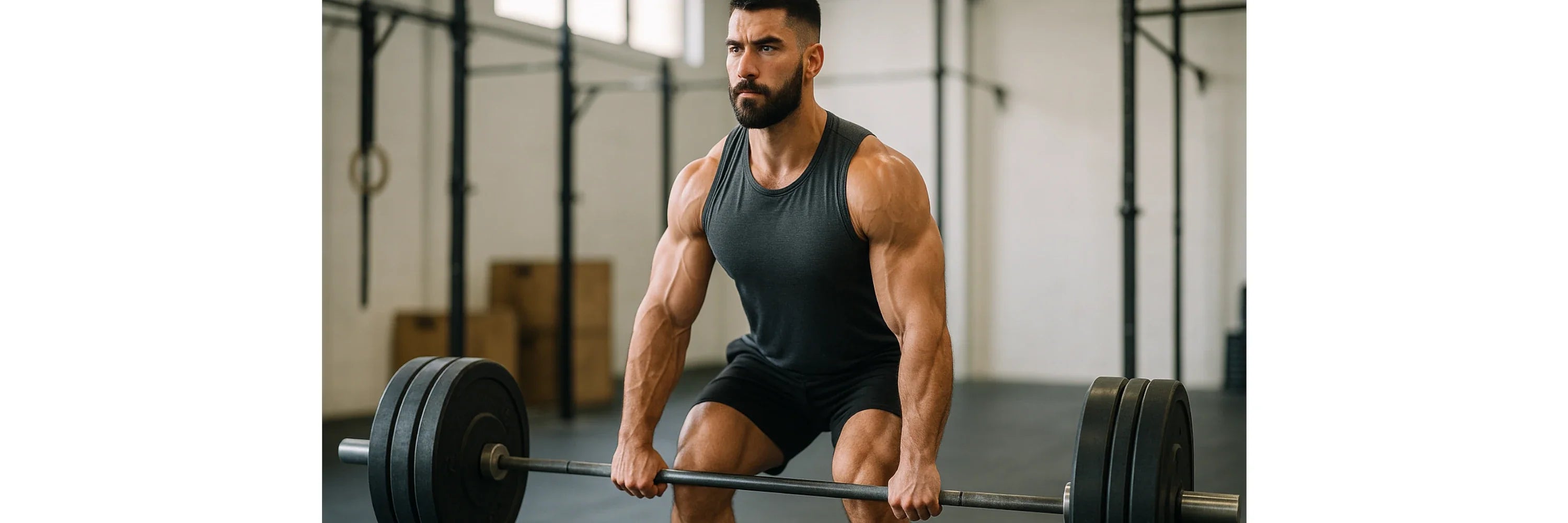
What are the benefits of Romanian deadlifts for your training?
When performing classic squats and deadlifts, it is often forgotten that the hamstrings and glutes should be heavily involved in the exercise. If this is not the case, you are leaving a great deal of potential on the table. It is often not that easy to specifically engage these two muscles during deadlifts and squats. The Romanian deadlift, also known as the RDL, is perfect for improving the recruitment of the posterior chain and training it effectively. But what exactly makes the Romanian deadlift so special? Who actually invented it and where did it get its name? In this article, we dive into the history of the Romanian deadlift, look at how it is performed correctly, and what this exercise can do for the rest of your training.
What is the Romanian deadlift
The RDL is a variation of the deadlift in which the weight is not lifted from the floor, but rather lowered and raised from a standing position. Unlike the classic deadlift, the focus is not on moving the maximum amount of weight, but on a controlled stretch of the posterior chain, especially the hamstrings and the gluteal muscles.
The exercise is particularly effective for:
- Building muscle in the hip extensors
- Engaging the hamstrings and glutes
-
Strengthening the lower back
Where does the Romanian deadlift come from
The name Romanian deadlift originates from the Romanian weightlifter Nicolae Vlad. He is a multiple world champion and Olympic gold medalist. In the early 1990s, Nicolae was training in the USA, where American coaches observed him performing an exercise that was new to them. He performed the movement with a controlled hip hinge, where the barbell stayed close to his body and did not start from the floor. The coaches asked what the exercise was called, to which Nicolae replied in essence: "That's just what we do in Romania." Thus, the Romanian deadlift was born and found its way into Western training plans, from where it spread worldwide.
What is the correct Romanian deadlift technique
Starting position
- Stand with your feet hip-width apart, barbell in front of your thighs
- Grasp the bar with your hands slightly wider than your hips
- Back straight, shoulder blades slightly back, knees slightly bent
Lowering (hinge movement)
- Push your hips back in a controlled manner
- The upper body tilts forward, the bar stays close to your body
- The knees remain slightly bent but do not move forward
- Feel the stretch in your hamstrings
- Stop as soon as you feel the maximum stretch (usually at shin height)
- The back remains neutral throughout
Rising
- Activate your glutes and hamstrings and return to the starting position
- The hips are pushed forward without arching the lower back
The exercise can be performed with a barbell or two dumbbells.
Primary muscles involved in the RDL
The Romanian deadlift is one of the most effective exercises for specifically strengthening the posterior chain.
- Hamstrings
- Gluteus maximus
- Erector spinae (spinal erectors)
- Adductors (supporting)
-
Core (for stabilization)
These muscle groups are crucial for stability, power transfer, and injury prevention, especially during functional movements in everyday life or sports.
Who should train with RDLs
The Romanian deadlift is suitable for almost anyone who wants to become stronger, more mobile, and more resilient. It is particularly recommended for people who want to train their posterior chain specifically and improve muscle recruitment. Athletes from sports such as CrossFit, weightlifting, powerlifting, or track and field use the Romanian deadlift to improve hip extension, which is a central movement impulse for sprints, jumps, and heavy lifts. Due to the controlled movement, the RDL is also excellent for technique training, especially for learning the so-called "hip hinge" movement—a key movement in many exercises. Try performing a few repetitions of Romanian deadlifts as a primer before your classic deadlifts. The weight should be moderate, and focus on engaging your hamstrings and glutes.
Conclusion
The Romanian deadlift is much more than just a technical supplement to the classic deadlift. It is a key standalone exercise with enormous added value for your entire training regimen. By specifically focusing on the posterior chain, it not only helps you build muscle but also improves your movement quality, power transfer, and injury resistance. Whether in strength training, CrossFit, weightlifting, or as a balance to daily life—anyone who wants to remain strong, mobile, and resilient in the long term should regularly anchor the RDL in their training plan. Performed correctly, it will bring you not only stronger legs and powerful glutes, but also better control over your entire body.



