
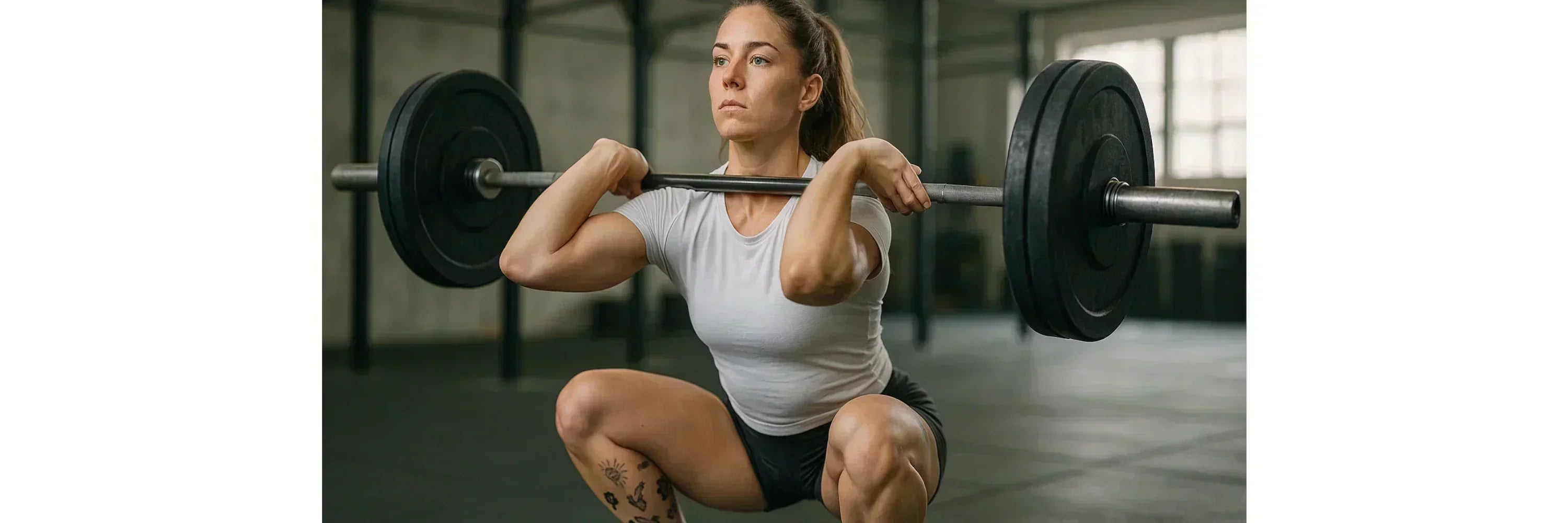
Strength standards table for men and women (kg)
Anyone who trains regularly in a CrossFit box or a weightlifting club lives in a world outside the average. Here, what seems almost superhuman outside is normal: cleaning 100 kg, squatting 150 kg, deadlifting 200 kg. But what does it look like when you zoom out of this training bubble? Suddenly, you are the person who carries crates of water with one hand, moves furniture without help, and looks in your spare time as if you had accidentally forgotten how to wear shirts with sleeves. The problem: inside this bubble, you still quickly appear average. Because you are constantly surrounded by fit, strong people, you easily underestimate what you are actually achieving. But where do you actually stand compared to other trainees and the world population? The so-called Strength Standards provide you with a clear table for this.
In a nutshell
Brain food for in between.
- Functional strength counts in everyday life.
- Average in a group of athletes means above average in the general population.
- The most important thing is the comparison with yourself.
And here we go
What does "strong" even mean?
The term strong on its own doesn't really say much unless you define it a bit more precisely. There are different types of strength:
Absolute strength: How much weight you can move in total. For example, your 1RM in the deadlift.
Relative strength: How much weight you move in relation to your body weight. Whether a 90 kg athlete lifts 140 kg or a 60 kg athlete does makes a difference.
Functional strength: How effectively you can use your strength in everyday life or for specific movements.
In the end, functional strength is often what counts in everyday life. In other words, how useful your strength is. Nevertheless, the maximum values from powerlifting and weightlifting are a good benchmark for comparison.
How strong is the average person – Strength standards at a glance
It gets exciting when you look at the numbers in more detail. These average values are known as Strength Standards. According to datasets from strengthlevel.com, which are based on over a million real training performances, the average maximum strength in the deadlift, squat, and bench press is in roughly these ranges:
|
Exercise |
Man (80 kg body weight) |
Woman (60 kg body weight) |
|
Deadlift |
approx. 125 kg |
approx. 65 kg |
|
Squat |
approx. 105 kg |
approx. 42 kg |
|
Bench Press |
approx. 85 kg |
approx. 30 kg |
These values correspond to a typical gym-goer, i.e., someone who trains regularly but is not a competitive athlete. If you compare this with the general population, including those who do not train at all, you quickly realize that with almost any reasonably consistent training career, you are already stronger than average.
For example:
An 80 kg man who can deadlift 140 kg is already in the top 15% of all trainees worldwide. For women, the same applies: those who lift 80 kg are also in the upper range – often stronger than 90% of all women who go to the gym.
This means: If you regularly train your basic exercises, you have long since moved into a performance tier that the average citizen doesn't even know exists.
Where do you stand in comparison?
To help you better categorize yourself, here is a rough grid of strength levels relative to body weight:
|
Level |
Deadlift |
Squat |
Bench |
|
Untrained |
0.5× body weight |
0.4× |
0.3× |
|
Trained |
1–1.25× |
0.8–1× |
0.6–0.8× |
|
Advanced |
1.5–2× |
1.25–1.75× |
1–1.25× |
|
Elite |
2.5× and more |
2× and more |
1.5× and more |
Take, for example, a 70 kg athlete who regularly does CrossFit:
A 100 kg deadlift, 80 kg squat, and 55 kg bench – that might be normal in the box, but in global figures, this is already an advanced level.
The same applies to men: anyone who lifts 1.5× their body weight and squats 1.25× is already in the top 10–15%.
Why you still underestimate your performance
This is due to selective perception. People always assess their abilities in relation to their environment. If you are constantly measuring yourself against exceptionally fit people, your own performance appears less spectacular than it is. Social media further amplifies this effect. You see clips of people lifting 300 kg, performing ring muscle-ups or handstand push-ups without problems. But you never see the millions who struggle with an empty barbell, can't do a single pull-up, or don't train at all. Our perception is distorted as a result. We don't see the normal distribution, only the extremes. Yet, average is not bad – on the contrary: average in a group of top athletes means you are objectively above average in the general population. In the CrossFit box, a 150 kg deadlift is considered solid. Outside in everyday life, that is weight that four people would have to lift together. Perspective is everything.
How to realistically assess how strong you are
If you want to objectively assess your strength, three simple steps will help:
Compare your values with the Strength Standards: These show you exactly where you stand compared to others – sorted by body weight, gender, and exercise. This is much more realistic than measuring yourself against the strongest athletes in your box.
Calculate your strength-to-bodyweight ratio: Divide your 1RM by your body weight. Values of over 1.5× in the deadlift or 1.25× in the squat are already strong. When it comes to the bench, anything above your own body weight is impressive.
Consider CrossFit benchmarks: Benchmark WODs are a good way to compare your progress over time.
Measure long-term development: The most important metric is not your PR – but your progression. If you have become stronger over the last 12 months, you are on track.
Why real strength is more than just the weight on the bar
Strength is not just a number, but also a state: physical, mental, emotional. The ability to go to training week after week, to challenge yourself, to cope with setbacks is also a strength. A PR is fleeting. But discipline, technique, and attitude remain. Therefore: anyone who trains regularly, takes setbacks in their stride, and gets back up anyway is stronger than many who only strive for numbers. And sometimes strength shows itself very unobtrusively: when you go to training despite a long day at work.
Conclusion
If you train regularly, improve your technique, and challenge yourself week after week, you have long been part of a minority. You move weights that are unimaginable to most people, even if they seem commonplace to you in your box. The training bubble distorts perception, but a look beyond its edge shows: what you achieve is extraordinary. Strength is more than numbers on a barbell. It shows itself in consistency, discipline, and the ability to keep going despite fatigue or setbacks. Every set, every repetition, every training session shapes not just muscles, but character. So, the next time you think your PR is not worth mentioning: remember that you are stronger than 95% of people out there.



