
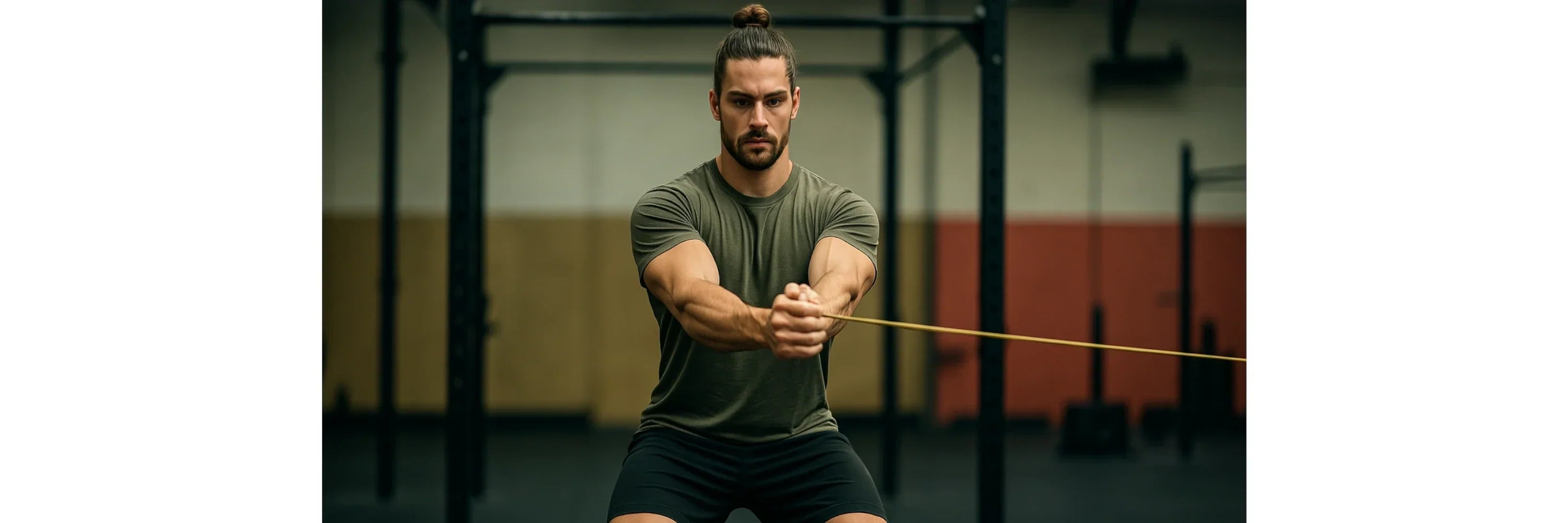
How to perform the Pallof Press correctly — the underrated core exercise
When it comes to training the core, many people automatically think of classic sit-ups, leg raises, planks, or Russian twists. Yet there is one exercise that is not as well-known and is often underestimated, even though it ranks highly in terms of functionality and effectiveness: the Pallof Press. It is minimalist but highly effective and suitable for anyone who wants to make their body more stable, injury-resistant, and powerful. In this article, we will look at exactly what the Pallof Press is, why it is such a great exercise, which muscles you are training with it, and how to perform it correctly.
What is the Pallof Press and who invented it
The Pallof Press is an anti-rotational exercise. This means you are not primarily training through movement, but rather by preventing movement. More precisely, your body works against the force trying to rotate it to the side—in other words, against a rotational force acting upon it. The exercise was popularized by American physical therapist John Pallof in the early 2000s. He originally used it in rehab and athletic training to specifically strengthen deep core muscles. Today, it is used worldwide by athletes, therapists, and trainers.
Why is anti-rotation important
In almost all sports and in everyday life, our body is constantly busy compensating for movements. Whether we are carrying something on one side, sprinting, lifting, or throwing, forces are created that try to twist us or knock us off balance. Our task is to withstand these forces in order to remain efficient and healthy. This is exactly where the Pallof Press comes in. It trains your ability to remain stable when your body actually wants to give in. In doing so, it strengthens not only your muscles but also your body control and movement economy.
Which muscles are activated during the Pallof Press
Although it might not look like it at first glance, the Pallof Press is a very holistic exercise. The focus is on the core, specifically the obliques and the transversus abdominis, a deep, belt-like muscle that stabilizes your torso like a natural weightlifting belt. However, other muscle groups are involved as well: your back muscles work to keep your spine upright, and depending on the variation, your glutes and shoulders are also involved, especially if you are training while standing or on one leg. Seen this way, the Pallof Press is more than just a pure core exercise; it is functional full-body training in a compact form.
How to perform the exercise correctly
As an example, we will use the standing version with a resistance band.
The steps apply equally to bands and cable machines—only the feel of the equipment differs. The band provides progressive resistance: the further you move from the anchor point or extend your arms, the harder it pulls. The cable machine keeps the load constant throughout the entire movement, which makes the resistance more precise in the gym. At home or on the go, the band is the easier choice; at the gym, go for the cable machine.
- Attach the band at chest height to a fixed point (e.g., a post or rack).
- Stand sideways to the band so that it tries to pull you to the side.
- Grab the band with both hands and bring it to your chest under tension.
- Engage your core, keep your pelvis neutral, and your shoulders down.
- Slowly and controllably extend your arms forward—ensure your torso does not rotate with the movement.
- Hold the position for a moment and then slowly bring your arms back to your chest.
-
Repeat the movement for 8–12 repetitions and then switch sides.
The quality of the movement is crucial. It is not about speed or maximum load, but about control and body tension.
What are the benefits of the Pallof Press
The Pallof Press offers a variety of benefits. For beginners, it is an excellent way to build core stability without putting significant stress on the joints or spine. Advanced athletes benefit from the targeted activation of deep muscles that are often neglected but are crucial for performance and injury prevention. It is easy to integrate into any workout, whether as a warm-up, activation exercise, or finisher. Furthermore, you need almost no equipment, making it an ideal exercise for home, travel, or the gym. For sports like CrossFit, weightlifting, or functional fitness, the Pallof Press is particularly sensible. It improves body tension during complex lifts, protects the lower back, and strengthens the central body axis, which is important for many movements.
What variations are there
Another plus point of the Pallof Press is its versatility. You can perform the exercise in different positions, depending on how much stability you want to challenge or promote.
Standing: As described above.
Half-kneeling: In this version, the influence of the legs is reduced, placing an even stronger focus on the core.
Single-leg: The single-leg version additionally brings balance into play and activates the hip muscles particularly intensely.
Isometric hold: Isometric holding phases, where you keep your arms in an extended position for several seconds, are also effective—especially for control and core tension.
Rotation: If you like things a bit more dynamic, you can combine the exercise with a rotation. Press the band forward and then slowly rotate your torso in the opposite direction. This increases complexity and additionally trains mobility in the thoracic spine.
Cable machine: Instead of a resistance band, the exercise can also be performed on a cable machine. The process remains identical—attach the handle at chest height, stand sideways to the device, and extend your arms forward in a controlled manner. The constant resistance allows for finer weight adjustments and is ideal for progressive training in the gym.
What are typical mistakes with the Pallof Press
As with many simple exercises, the devil is in the details. A common mistake is shrugging the shoulders, which can lead to tension in the neck. Ensure you actively pull your shoulder blades down and back. Just as common is the unconscious rotation of the torso. This happens primarily when the resistance is too high. In that case, it is better to reduce the load and focus on proper form. A third mistake is a lack of core tension. If the tension in your hips or abdomen is missing, the training effect is lost. Therefore, consciously ensure that tension is maintained throughout your entire core during the exercise.
Conclusion
The Pallof Press is one of those exercises that may look unspectacular at first glance, but with regular use, it can work wonders for your core stability. It is easy to learn, can be done anywhere, and is incredibly effective, especially when performed with control and a focus on tension. Regardless of whether you are just starting out with training or are already ambitiously refining your skills: the Pallof Press is a valuable building block for more stability, better performance, and reduced injury risk. Give it a fixed place in your training plan.



