
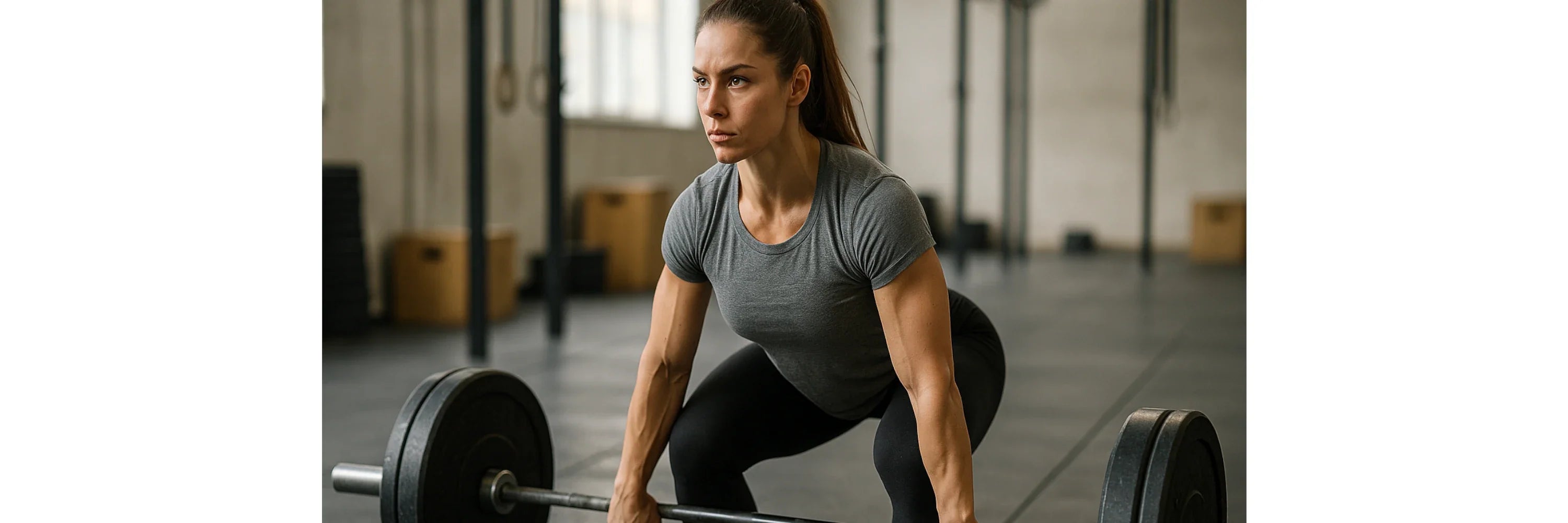
Deadlifts for maximum strength
The classic deadlift is one of the most fundamental and effective exercises in strength training. It is an exercise that may appear simple at first glance, but is incredibly profound in its execution and the resulting benefits.
Where does the name "deadlift" come from?
The term "deadlift" consists of the words "dead" and "lift." This name may seem a bit strange at first, but it has a simple and logical origin. The term refers to the fact that the weight being lifted in the exercise is "dead" on the ground. Unlike other exercises where the weight is moved from a certain position or after some momentum, the deadlift requires all force to be generated directly from a standing position to lift the weight from the floor into an upright posture. This challenge of lifting a "dead" weight off the floor gave the exercise its name and illustrates the intense physical effort required to perform it correctly.
A guide to the deadlift
Performing the deadlift is technically demanding and requires concentration and precision to ensure both maximum effectiveness and safety:
Starting position:
- Stand behind the barbell with your feet about shoulder-width apart. The barbell should be over the middle of your feet.
- Bend forward at the hips and grip the barbell with both hands. Your hands should be placed slightly wider than shoulder-width. Ideally, your shins should now be touching the barbell.
- Your knees should be slightly bent, your back straight, and your head in a neutral position, looking forward.
Building body tension:
- Pull your shoulder blades back and down to activate your back muscles and stabilize your torso.
- Engage your core by tightening your abdominal muscles. This helps keep the spine stable throughout the entire movement.
The lift:
- Push off the floor forcefully with your legs while simultaneously extending your hips forward. The barbell should move in a straight line up along your shins.
- It is important that the angle of your back to the floor does not change during the lift. Your butt must under no circumstances move upward first, followed by the rest of the upper body.
- Keep your back straight and your shoulders slightly behind the barbell as you pull it upward.
End position:
- Once you are in an upright position, your hips and knees should be fully extended, your shoulders pulled back, and your chest held proud.
- Maintain the tension briefly in this position before lowering the barbell back down in a controlled manner.
Returning to the starting position:
- Lower the barbell in a controlled manner by bending your hips and knees until the barbell rests on the ground again.
What is the purpose and benefit of the deadlift?
It is a comprehensive training exercise and offers numerous benefits:
Full-body strength: Deadlifting trains almost all major muscle groups in the body, including the leg muscles (especially the hamstrings), the lower back, the glutes, the core, and the forearms. This leads to a significant increase in overall body strength.
Functional fitness: The deadlift movement is extremely functional and carries over into many everyday activities, such as lifting heavy objects. It improves the ability to move heavy loads safely and effectively in the real world.
Improved posture: By strengthening the back muscles, the deadlift helps improve posture and prevent back problems. It is especially helpful for people who sit a lot or suffer from back pain.
High calorie burn: Because many large muscle groups are engaged simultaneously, deadlifting leads to a high calorie burn, making it an excellent exercise for weight loss and muscle building.
Hormonal response: Heavy lifting stimulates the production of anabolic hormones such as testosterone and growth hormones, which are crucial for muscle building and regeneration.
What types of grips are there for deadlifting?
Depending on your goal and individual comfort, different gripping techniques can be used for deadlifting:
Double overhand grip: Both hands grip the barbell with palms facing down. This is the simplest and most common grip, which promotes symmetrical strength development, but grip strength can fail with very heavy weights.
Mixed grip: One hand grips with an overhand grip, the other with an underhand grip. This grip increases grip strength and allows for lifting heavier loads, as the barbell can no longer rotate out of the grip. However, there is a slight risk of muscular imbalances, which is why some athletes switch grip sides regularly. In addition, it can be more difficult to engage both lats evenly.
Hook grip: In this technique, the thumb is tucked under the fingers, which provides a very strong grip. The hook grip is particularly popular for heavy lifting, but can be uncomfortable at first.
Lifting straps: Straps are wrapped around the wrists and the bar to support grip strength. They are useful when grip strength is the limiting factor, but should be used sparingly so as not to neglect natural grip strength.
Conclusion
The deadlift is an indispensable exercise in strength training that offers a multitude of benefits, from increasing full-body strength to improving posture and promoting functional fitness. It is an exercise that is both simple and complex, depending on the execution and the grip techniques used. Whether you are a beginner or an experienced athlete, the deadlift should be a central part of every training program, as it forms the basis for strong, functional, and well-developed musculature.



